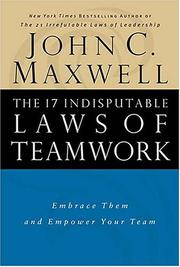
17 indisputable laws of teamwork
John C. Maxwell · 2001
על הספר
To achieve great things, you need a team. Building a winning team requires understanding of these principles. Whatever your goal or project, you need to add value and invest in your team so the end product benefits from more ideas, energy, resources, and perspectives. 1. The Law of Significance People try to achieve great things by themselves mainly because of the size of their ego, their level of insecurity, or simple naiveté and temperament. One is too small a number to achieve greatness. 2. The Law of the Big Picture The goal is more important than the role. Members must be willing to subordinate their roles and personal agendas to support the team vision. By seeing the big picture, effectively communicating the vision to the team, providing the needed resources, and hiring the right players, leaders can create a more unified team. 3. The Law of the Niche All players have a place where they add the most value. Essentially, when the right team member is in the right place, everyone benefits. To be able to put people in their proper places and fully utilize their talents and maximize potential, you need to know your players and the team situation. Evaluate each person’s skills, discipline, strengths, emotions, and potential. 4. The Law of Mount Everest As the challenge escalates, the need for teamwork elevates. Focus on the team and the dream should take care of itself. The type of challenge determines the type of team you require: A new challenge requires a creative team. An ever-changing challenge requires a fast, flexible team. An Everest-sized challenge requires an experienced team. See who needs direction, support, coaching, or more responsibility. Add members, change leaders to suit the challenge of the moment, and remove ineffective members. 5. The Law of the Chain The strength of the team is impacted by its weakest link. When a weak link remains on the team the stronger members identify the weak one, end up having to help him, come to resent him, become less effective, and ultimately question their leader’s ability. 6. The Law of the Catalyst Winning teams have players who make things happen. These are the catalysts, or the get-it-done-and-then-some people who are naturally intuitive, communicative, passionate, talented, creative people who take the initiative, are responsible, generous, and influential. 7. The Law of the Compass A team that embraces a vision becomes focused, energized, and confident. It knows where it’s headed and why it’s going
פרטי הספר
- שנה
- 2001
- שפה
- English
- הוצאה
- Thomas Nelson
- מהדורות
- 1
- ISBN
- 9780785260325
מקור הנתונים: Wikidata
עוד של John C. Maxwell