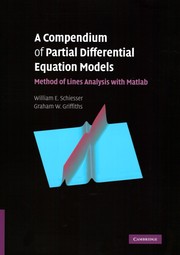
A compendium of partial differential equation models
W. E. Schiesser · 2009
על הספר
In the analysis and the quest for an understanding of a physical system, generally, the formulation and use of a mathematical model that is thought to describe the system is an essential step. That is, a mathematical model is formulated (as a system of equations) which is thought to quantitatively define the interrelationships between phenomena that define the characteristics of the physical system. The mathematical model is usually tested against observations of the physical system, and if the agreement is considered acceptable, the model is then taken as a representation of the physical system, at least until improvements in the observations lead to refinements and extensions of the model. Often the model serves as a guide to new observations. Ideally, this process of refinement of the observations and model leads to improvements of the model and thus enhanced understanding of the physical system. However, this process of comparing observations with a proposed model is not possible until the model equations are solved to give a solution that is then the basis for the comparison with observations. The solution of the model equations is often a challenge. Typically in science and engineering this involves the integration of systems of ordinary and partial differential equations (ODE/PDEs). The intent of this volume is to assist scientists and engineers in this process of solving differential equation models by explaining some numerical, computer-based methods that have generally been proven to be effective for the solution of a spectrum of ODE/PDE system problems. For PDE models, we have focused on the method of lines (MOL), a well established numerical procedure in which the PDE spatial (boundary value) partial derivatives are approximated algebraically, in our case, by finite differences (FDs). The resulting differential equations have only one independent variable remaining, an initial value variable, typically time in a physical application. Thus, the MOL approximation replaces a PDE system with an initial value ODE system. This ODE system is then integrated using a standard routine, which for the Matlab analysis used in the example applications, is one of the Matlab library integrators. In this way, we can take advantage of the recent progress in ODE numerical integrators. However, whilst we have presented our MOL solutions in terms of Matlab code, it is not our intention to provide optimised Matlab code but, rather, to provide code that will be readi
פרטי הספר
- שנה
- 2009
- שפה
- English
- הוצאה
- Cambridge University Press
- מהדורות
- 2
- עמודים
- 474
- ISBN
- 9780521519861
מקור הנתונים: Wikidata
עוד של W. E. Schiesser