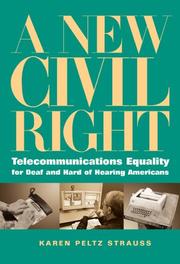
A new civil right
Karen Peltz Strauss · 2009
על הספר
"More than 300 years ago a physicist, Guillaume Amontons, stood on a hillside in Meudon, France, and, using a series of windmills, sent a message to Belleville and then to Paris. He received a response by similar signals, letters of the alphabet attached to the windmill vanes, which were read with a telescope. This experiment in "tele" (distance) communications, although successful, failed in its attempt to acquire funding from his government. Ironically, Amontons was a deaf man who proposed a system for long-distance communications access for the hearing world. A New Civil Right is a welcomed summary of the last half century's battles and breakthroughs by deaf and hearing people in the United States for local, state, and federal legislation. Strauss, a telecommunications policy advocate, was part of the revolution which changed our lives. She provides firsthand details of the legislative movement toward telephone and television (captioning) and the access.^ Shift of telephone companies and others from a charitable or "social services" perspective to one that such access is a civil right to which deaf and hard-of-hearing people are entitled. Strauss covers the gamut of the legal movement toward access--from the initial use of modems with teleprinters of the l960s to the current wireless world. As a hearing person with many deaf friends and contacts, she personally experienced the frustrations of using telecommunications access services--and these experiences provided a motivating force for her own involvement in the battles to implement laws. Chapters on the development and implementation of relay services outline comprehensively one of the greatest triumphs for deaf people in the United States. The chapter titled "In Case of Emergency" is particularly moving.^ It describes personal experiences of deaf persons with medical emergencies, the lack of visual emergency bulletins on television during earthquakes and other severe weather events around the country, and the involvement of deaf and hearing people in the battle to propel the Federal Communications Commission into action. Several chapters cover the history that led to closed captioning on television, a welcomed documentation for scholars and general readers alike. There is also coverage of hearing aid-compatible telephone technology. "A Wireless World" details how digital wireless technologies required still another battle to assure access. Universal Design as it relates to telecommunications is also
פרטי הספר
- שנה
- 2009
- שפה
- English
- הוצאה
- Gallaudet University Press
- מהדורות
- 1
- ISBN
- 9781563683817
מקור הנתונים: Wikidata