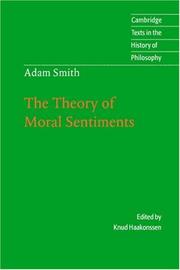
Adam Smith
Adam Smith · 2002
איפה לקנות
בדקו את המחיר העדכני באמזון. אנחנו לא מציגים מחירים כי הם משתנים מדי יום.
לצפייה באמזוןקישור שותפים. בתור שותפים של Amazon אנחנו מרוויחים מרכישות מתאימות.
על הספר
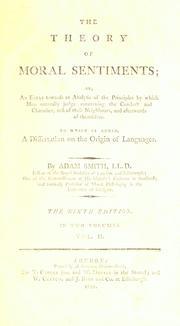
The Theory of Moral Sentiments, written by Adam Smith in 1759, was one of the most important works in the theory of capitalism. It provided the ethical, philosophical, psychological and methodological underpinnings to Smith's later works, including The Wealth of Nations (1776) — Excerpted from The Theory of Moral Sentiments on Wikipedia, the free encyclopedia. {From Wikipedia : Adam Smith http://en.wikipedia.org/wiki/Adam_Smith} In 1759, Smith published his first work, The Theory of Moral Sentiments. He continued making extensive revisions to the book, up until his death.[N 2] Although The Wealth of Nations is widely regarded as Smith's most influential work, it is believed that Smith himself considered The Theory of Moral Sentiments to be a superior work.[60] In the work, Smith critically examines the moral thinking of his time, and suggests that conscience arises from social relationships.[61] His goal in writing the work was to explain the source of mankind's ability to form moral judgements, in spite of man's natural inclinations towards self-interest. Smith proposes a theory of sympathy, in which the act of observing others makes people aware of themselves and the morality of their own behavior.[62] Scholars have traditionally perceived a conflict between The Theory of Moral Sentiments and The Wealth of Nations; the former emphasizes sympathy for others, while the latter focuses on the role of self-interest.[63] In recent years, however, some scholars[64][65][66] of Smith's work have argued that no contradiction exists.[67] They claim that in The Theory of Moral Sentiments, Smith develops a theory of psychology in which individuals seek the approval of the "impartial spectator" as a result of a natural desire to have outside observers sympathize with them. Rather than viewing The Wealth of Nations and The Theory of Moral Sentiments as presenting incompatible views of human nature, some Smith scholars regard the works as emphasizing different aspects of human nature that vary depending on the situation. These views ignore that Smith's visit to France (1764–66) changed radically his former views and that The Wealth of Nations is an inhomogeneous convolute of his former lectures and of what Quesnay taught him.[68] Before his voyage to France in The Theory of Moral Sentiments, Adam Smith refers to an "invisible hand" ("By preferring the support of domestic to that of foreign industry, [an individual] intends only his own security; and by directing that in
פרטי הספר
- שנה
- 2002
- שפה
- English
- הוצאה
- Cambridge University Press
- מהדורות
- 2
- עמודים
- 446
- ISBN
- 9780521591508
מקור הנתונים: Wikidata
עוד של Adam Smith