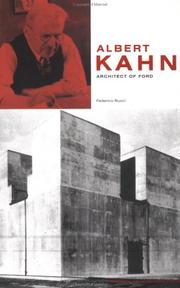
Albert Kahn
Federico Bucci · 1993
איפה לקנות
בדקו את המחיר העדכני באמזון. אנחנו לא מציגים מחירים כי הם משתנים מדי יום.
לצפייה באמזוןקישור שותפים. בתור שותפים של Amazon אנחנו מרוויחים מרכישות מתאימות.
על הספר
Albert Kahn's contribution to North American industrial architecture is best characterized by a simplicity of expression in his designs of flexible spaces for manufacturing and production. Working in Detroit, Kahn began a long and fruitful collaboration with the automobile mogul Henry Ford, that was based on a shared vision of modernism and industry. Kahn rapidly established himself as an architect capable of responding to the new demands of mass production by employing the patented system of reinforced concrete developed by his brother, an engineer. Guided by functionalist principles and a sense of manufacturing organizations, Kahn anticipated assembly line operations and developed innovative typological characteristics for the modern factory. His projects included Ford Motor Company River Rouge Plant, Dearborn, Michigan; Burroughs Adding Machine Company, Detroit, Michigan; Tractor Plant, Stalingrad, Russia; General Motors Building, Chicago World's Fair; and Kellogg Company, Battle Creek, Michigan. Through incisive text, Albert Kahn - part of a growing series with Adalberto Libera and Adolf Loos - brings to light the novelty of Kahn's designs and his advancement of the machine aesthetic. Over ninety black-and-white photographs and drawings illustrate the extensive number of projects realized by "the architect of Ford."
המשפט הראשון: "Albert Kahn was born in Rhaunen, Germany (near Frankfurt) on March 21, 1869, the first son of Rosalie and Rabbi Joseph Kahn."
פרטי הספר
- שנה
- 1993
- שפה
- English
- הוצאה
- Princeton Architectural Press
- מהדורות
- 3
- עמודים
- 200
- ISBN
- 9781568983431
מקור הנתונים: Wikidata
עוד של Federico Bucci