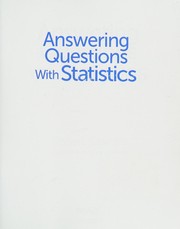
Answering questions with statistics
Robert F. Szafran · 2012
איפה לקנות
המחיר באמזון משתנה מדי יום, אז הכי נכון לראות אותו שם ברגע הקנייה.
לצפייה באמזוןזה קישור שותפים: כשקונים דרכו, האתר מקבל עמלה קטנה בלי תוספת במחיר עבורכם, וזה עוזר לנו להביא תוכן איכותי ולתחזק את האתר. בתור שותפים של Amazon אנחנו מרוויחים מרכישות מתאימות.
על הספר
"The book is divided into three Parts: Part One has chapters that introduce data analysis and SPSS; Part Two contains eight chapters on descriptive statistics that begin with frequency tables and go through multiple regression; and Part Three includes six chapters on inferential statistics. Part One: Getting Started begins by answering some questions most students have right at the start © questions like why study data analysis and how much math and computer knowledge is required? Essential concepts from research methods relevant for data analysis are also explained. Part Two: Descriptive Statistics: Answering Questions about Your Data demonstrates procedures to use when the analyst is only concerned with describing the cases for which he or she actually has data. Statistics summarizing single variables (univariate statistics) are presented first and then statistics summarizing relationships between variables (multivariate statistics). Frequency tables, measures of central tendency, measures of dispersion, crosstabs, measures of association, subgroup means, and regression are all covered as are bar charts, pie charts, histograms, and clustered bar charts. Part Three: Inferential Statistics: Answering Questions about Populations explains procedures which allow the analyst to draw conclusions about the population from which his or her sample of cases was randomly selected. It begins with a simple chapter on the statistical theory behind inferential statistics. A four-step approach to hypothesis testing is introduced in the next chapter and demonstrated with one-sample t test hypotheses. The remaining chapters present different types of hypothesis tests including paired-samples, independent-samples, one and two-way ANOVA, and chi-square"-- "The book is divided into three Parts: Part One has chapters that introduce data analysis and SPSS; Part Two contains eight chapters on descriptive statistics that begin with frequency tables and go through multiple regression; and Part Three includes six chapters on inferential statistics. Part One: Getting Started begins by answering some questions most students have right at the start - questions like why study data analysis and how much math and computer knowledge is required? Essential concepts from research methods relevant for data analysis are also explained. Part Two: Descriptive Statistics: Answering Questions about Your Data demonstrates procedures to use when the analyst is only concerned with describing the cas
פרטי הספר
- שנה
- 2012
- שפה
- English
- הוצאה
- Sage Publications, Inc
- מהדורות
- 3
- עמודים
- 429
- ISBN
- 9781412991322
מקור הנתונים: Wikidata
עוד של Robert F. Szafran