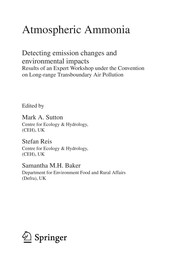
Atmospheric Ammonia
Mark A. Sutton · 2009
על הספר
Atmospheric ammonia is increasingly being recognized as a pollutant of key environmental concern. Ammonia contributes to several environmental problems, including direct toxic effects on vegetation, atmospheric nitrogen deposition, leading to the eutrophication and acidification of sensitive ecosystem, and to the formation of secondary particulate matter in the atmosphere, with effects on human health, atmospheric visibility and global radiative balance. Ammonia emissions are increasing rapidly in many parts of the world, so that these environmental concerns are expected to grow in future. In Europe, efforts are currently being made to reduce ammonia emissions, alongside reductions in other air pollutants, notably sulphur dioxide and nitrogen oxides. However, reducing ammonia emissions has proved uncertain and challenging, with only modest regional reductions achieved to date. As the emissions of sulphur dioxide and nitrogen oxides are reduced, ammonia is therefore increasingly dominating the air pollution climate of Europe and the consequent environmental impacts. It was in this context that the leading international experts met in Edinburgh in December 2006 under the auspices of the UN-ECE Convention on Long Range Transboundary Air Pollution to review the current state of the science of ammonia in the atmosphere. Specifically, the international workshop was a joint effort between several bodies of the Convention: the Ammonia Expert Group, the Working Group on Effects and the Task Force on Measurement and Modelling, together with the COST 729 and the NitroEurope Integrated Project. This book reports the underpinning information in the form of several major reviews, combined with supporting chapters on recent research results, to provide an up-to-date scientific synthesis in relation to four key themes: Re-evaluation of the critical thresholds for ammonia effects on sensitive plants and habitats Review of approaches for downscaling transboundary assessments to deal with ammonia hotspots in relation to operational modelling and monitoring Review of regional scale atmospheric transport and chemistry models in relation to their formulation and results for ammonia. Each of these themes is of fundamental to the quantification of ammonia impacts in the environment and the assessment of possible abatement measures. The reviews highlight how the critical threshold for ammonia concentrations – the "critical level" – has been overestimated in the past, and the book
פרטי הספר
- שנה
- 2009
- שפה
- English
- הוצאה
- Springer Netherlands
- מהדורות
- 1
- עמודים
- 464
- ISBN
- 9781402091209
מקור הנתונים: Wikidata
עוד של Mark A. Sutton