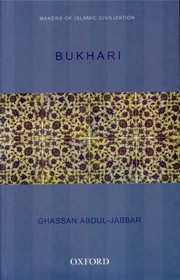
Bukhari
Ghassan Abdul-Jabbar · 2007
איפה לקנות
בדקו את המחיר העדכני באמזון. אנחנו לא מציגים מחירים כי הם משתנים מדי יום.
לצפייה באמזוןקישור שותפים. בתור שותפים של Amazon אנחנו מרוויחים מרכישות מתאימות.
על הספר
Chiefly study on Jāmiʻ al-ṣaḥīḥ by Muḥammad ibn Ismāʻīl Bukhārī, 810-870; includes his brief biography. The book places Bukhari in the context of an intellectual history of the period: yes it uses a careful study of the Sahih as its primary source. Here are some excerpts from the introduction and conclusion that describe the book quite well: [FROM the introduction] I have chosen to deal with two important issues relating to Bukhari’s scholarly life. Literary criticism has trained the modern mind in a way that should make discussion of how text yields meaning familiar to the reader. Bukhari’s approach to verification should be familiar to the modern reader since it is like the modern concern for verifying the academic apparatus supporting a text. These two issues seemed close at hand so I have limited myself to dealing with them. [FROM the introduction] the substance of this book is in Chapters 3–5. Chapters speak 3 and 4 address the problem of assigning meaning to Hadith texts, Bukhari’s way of doing this, and of how others approached this issue. Chapter 5 describes the problem of verifying the authenticity of texts: how Bukhari did this and how others did it differently. In this brief work I have limited the discussion to the two issues of meaning and verification. In each case, I have used instances from Bukhari’s works to show how he has dealt with these issues, and I have tried to put his work in the context of approaches other scholars have taken. [FROM the introduction: on approach:] Modern Muslims are interested in Bukhari’s Sahih primarily as a collection of texts that come to us with sound documentation. They have only mild curiosity about why Bukhari chose to record a certain Hadith or what he was trying to say in recording the Hadith in a certain way. They would treat Bukhari and his Sahih as a perfectly transparent medium through which they can view the Prophet directly. Non-Muslim scholars are also only indirectly interested in Bukhari's work. Goldziher...stated "The hadith... [will serve as a] ... reflection of tendencies which appeared in the community during the later stages of its development." I have tried to provide Bukhari and his work contexts that are contemporary to his work. I have reserved centre stage for what Bukhari thought he was doing, the controversies he was addressing, the stand he took in them, and how his work affected the progress of these controversies. [FROM the Conclusion:] ...two very important intellectual projects
פרטי הספר
- שנה
- 2007
- שפה
- English
- סדרה
- Makers of Islamic civilization
- הוצאה
- Oxford University Press
- מהדורות
- 1
- עמודים
- 145
- ISBN
- 9780195676563
מקור הנתונים: Wikidata