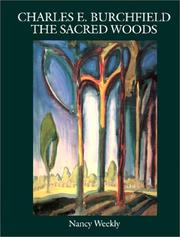
Charles E. Burchfield
Nancy Weekly · 2023
איפה לקנות
בדקו את המחיר העדכני באמזון. אנחנו לא מציגים מחירים כי הם משתנים מדי יום.
לצפייה באמזוןקישור שותפים. בתור שותפים של Amazon אנחנו מרוויחים מרכישות מתאימות.
על הספר
Charles E. Burchfield: The Sacred Woods explores the underlying spirituality of American painter Charles E. Burchfield (1893-1967). Author Nancy Weekly, the Charles Cary Rumsey Curator of the Burchfield Art Center, traces the evolution of his art and philosophical fluctuations. She identifies his affinity for developments in 19th century art and literature, including pantheism, luminism, romanticism, and transcendentalism. The book celebrates the 100th anniversary of Burchfield's birth. It is complemented by 40 color plates and 60 black and white illustrations. Burchfield was born in 1893 in Ashtabula, Ohio, and grew up in Salem, Ohio, which is depicted in youthful studies of nature, painted until he graduated from the Cleveland School of Art in 1916. His early work shares decorative compositional qualities with 19th century Japanese woodblock prints and reveals the influence of prevalent pantheistic philosophies and the literature of American authors, such as Henry David Thoreau, Walt Whitman, and Ralph Waldo Emerson. During 1917, which Burchfield called his "golden year," he exaggerated nature's sounds and movements in synesthetic, animated fantasies and invented a highly personal set of symbols he called "Conventions for Abstract Thoughts" to represent dreaded human emotions such as fear and morbidness. Surprisingly, during the 1920s when Burchfield still harbored the doubts of his youthful apostasy, he produced a small number of prints, drawings, and paintings based on Biblical subjects. After designing wallpapers for the M. H. Birge & Sons Company in Buffalo, New York from 1921 to 1929, the artist resigned to devote himself fully to his painting, encouraged by Frank K. M. Rehn of New York, who offered to be his art dealer. Burchfield became known as a painter of the American Scene, the champion of unpretentious small town life, as well as the urban documentarian who recorded the ennui of a man-made landscape, often being compared with his Rehn Gallery colleague, Edward Hopper. Dissatisfied with painting realistically, Burchfield returned in the 1940s to his fanciful style of 1917 and expanded old ideas, even the actual paintings themselves, into larger and more meaningful interpretations of nature. A lifetime of spiritual soul-searching and self-doubt, the recurrence of serious illnesses, and the steady persuasiveness of his wife, Bertha, led to Burchfield's eventual adoption of the Lutheran faith in 1943-44. Autobiographical, romantic landscapes of t
פרטי הספר
- שנה
- 2023
- שפה
- English
- הוצאה
- Burchfield Penney Art Center
- מהדורות
- 3
- ISBN
- 9780997717068
מקור הנתונים: Wikidata