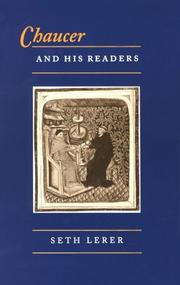
Chaucer and his readers
Seth Lerer · 1993
על הספר
Challenging the view that the fifteenth century was the "Drab Age" of English literary history, Seth Lerer seeks to recover the late-medieval literary system that defined the canon of Chaucer's work and the canonical approaches to its understanding. Lerer shows how the poets, scribes, and printers of the period constructed Chaucer as the "poet laureate" and "father" of English verse. Chaucer appears throughout the fifteenth century as an adviser to kings and master of technique, and Lerer reveals the patterns of subjection, childishness, and inability that characterize the stance of Chaucer's imitators and his readers. In figures from the Canterbury Tales such as the abused Clerk, the boyish Squire, and the infantilized narrator of the "Tale of Sir Thopas," in the excuse-ridden narrator of Troilus and Criseyde, and in Chaucer's cursed Adam Scriveyn, the poet's inheritors found their oppressed personae. Through close readings of poetry from Lydgate to Skelton, detailed analysis of manuscript anthologies and early printed books, and inquiries into the political environments and the social contexts of bookmaking, Lerer charts the construction of a Chaucer unassailable in rhetorical prowess and political sanction, a Chaucer aureate and laureate.
המשפט הראשון: PERHAPS the most dazzling of the few surviving pictures of a medieval English author is the frontispiece to Chaucer's Troilus and Criseyde in Corpus Christi College Cambridge MS 61 (reproduced in the Frontispiece, above).
פרטי הספר
- שנה
- 1993
- שפה
- English
- הוצאה
- Princeton University Press
- מהדורות
- 1
- עמודים
- 328
- ISBN
- 9780691029238
מקור הנתונים: Wikidata
עוד של Seth Lerer