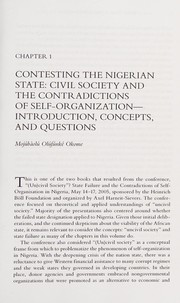
Contesting the Nigerian state
Nigeria) (Un)civil Society--State Failure and the Contradictions of Self-Organisation in Nigeria (2005 Lagos, M. Okome, Moj Okome · 2013
איפה לקנות
בדקו את המחיר העדכני באמזון. אנחנו לא מציגים מחירים כי הם משתנים מדי יום.
לצפייה באמזוןקישור שותפים. בתור שותפים של Amazon אנחנו מרוויחים מרכישות מתאימות.
על הספר
This book addresses the meanings and implications of self-organization and state society relations in contemporary Nigerian politics. The conventional wisdom in public choice theory is that self-organization could generate collective action problems, via the tragedy of the commons, or the prisoner's dilemma, or a condition akin to Hobbes' state of nature, where selfish interests produce social conflict rather than cooperation. In the absence or unwillingness of the state to provide such services, entire communities in Nigeria have had to band together to repair roads, build health centers, repair broken transformers owned by the public utilities company, all from levies. Consideration of post-authoritarian state-civil society relations in Nigeria began in a situation where the state was deeply embroiled in a morass of economic and political crises, further complicating these relations, and lending urgency to questions about state capacity, as well as the nature of the relationship between state and civil society, and their implication for the social, economic and political health and well being of the democratizing polity and its citizens.
פרטי הספר
- שנה
- 2013
- שפה
- English
- הוצאה
- Palgrave Macmillan
- מהדורות
- 4
- עמודים
- 259
- ISBN
- 9781137324528
מקור הנתונים: Wikidata