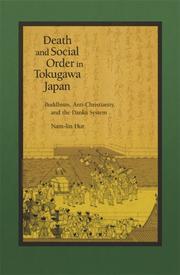
Death and Social Order in Tokugawa Japan
Nam-lin Hur · 2007
על הספר
Buddhism was a fact of life and death during the Tokugawa period (1600-1868): every household was expected to be affiliated with a Buddhist temple, and every citizen had to be given a Buddhist funeral. The enduring relationship between temples and their affiliated households gave rise to the danka system of funerary patronage. This private custom became a public institution when the Tokugawa shogunate discovered an effective means by which to control the populace and prevent the spread of ideologies potentially dangerous to its power--especially Christianity. Despite its lack of legal status, the danka system was applied to the entire population without exception; it became for the government a potent tool of social order and for the Buddhist establishment a practical way to ensure its survival within the socioeconomic context of early modern Japan. In this study, Nam-lin Hur follows the historical development of the danka system and details the intricate interplay of social forces, political concerns, and religious beliefs that drove this "economy of death" and buttressed the Tokugawa governing system. --From publisher description.
פרטי הספר
- שנה
- 2007
- שפה
- English
- הוצאה
- Harvard University Asia Center
- מהדורות
- 1
- עמודים
- 550
- ISBN
- 9780674025035
מקור הנתונים: Wikidata