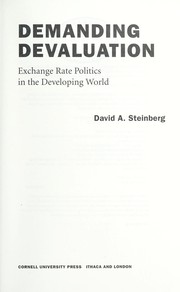
Demanding devaluation
David Steinberg · 2015
איפה לקנות
בדקו את המחיר העדכני באמזון. אנחנו לא מציגים מחירים כי הם משתנים מדי יום.
לצפייה באמזוןקישור שותפים. בתור שותפים של Amazon אנחנו מרוויחים מרכישות מתאימות.
על הספר
Exchange rate policy has profound consequences for economic development, financial crises, and international political conflict. Some governments in the developing world maintain excessively weak and "undervalued" exchange rates, a policy that promotes export-led development but often heightens tensions with foreign governments. Many other developing countries "overvalue" their exchange rates, which increases consumers' purchasing power but often reduces economic growth. In Demanding Devaluation, David Steinberg argues that the demands of powerful interest groups often dictate government decisions about the level of the exchange rate. Combining rich qualitative case studies of China, Argentina, South Korea, Mexico, and Iran with cross-national statistical analyses, Steinberg reveals that exchange rate policy is heavily influenced by a country's domestic political arrangements. Interest group demands influence exchange rate policy, and national institutional structures shape whether interest groups lobby for an undervalued or an overvalued rate. A country's domestic political system helps determine whether it undervalues its exchange rate and experiences explosive economic growth or if it overvalues its exchange rate and sees its economy stagnate as a result.--
פרטי הספר
- שנה
- 2015
- שפה
- English
- סדרה
- Cornell studies in money
- הוצאה
- Cornell University Press
- מהדורות
- 1
- עמודים
- 273
- ISBN
- 9780801453847
מקור הנתונים: Wikidata