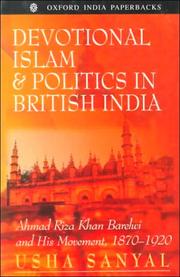
Devotional Islam and Politics in British India
Usha Sanyal · 1996
על הספר
Ahl-e Sunnat wa Jama'at, a religious movement led by a section of the Sunni Muslim 'ulama', and its prolific leader Maulana Ahmad Riza Khan are the central focus of this book. During the formative period of this movement, between the 1880s and 1920, the debates in which the Ahl-e sunnat 'ulama' engaged with other north Indian 'ulama' did not deal with the politics. The issues which concerned the Ahl-e Sunnat pertained mainly to religion. The 'ulama' tried to inculcate in individual Muslims a stricter adherence to the shari'a or law - to bring about reform or to engage in tajdid (renewal of faith). This effort at renewal was inspired in many instances by the example of the Prophet Muhammad. Seeing in him the perfect embodiment of obedience to the shari'a, they sought to follow the Prophet's sunna (way) in their own lives and taught other Muslims to do the same. Their efforts at reform resulted in the opening by them of schools, the publication of tracts and journals, and the writing of fatawas (legal rulings) on concrete problems raised by members of the community. Thus, in the absence of Muslim state power, the 'ulama' emerged as an important source of authority. Usha Banyal studies Ahmad Riza's fatawas and tracts in order to analyse the religious discourse of the Ahl-e Sunnat, which was at the core of a process of identity formation and which had wider ramifications for relations with competing Muslim and non-Muslim groups as well as the colonial state. This book will interest historians, students of religion, and scholars of Islam.
פרטי הספר
- שנה
- 1996
- שפה
- English
- הוצאה
- Oxford University Press, USA
- מהדורות
- 1
- עמודים
- 400
- ISBN
- 9780195648621
מקור הנתונים: Wikidata