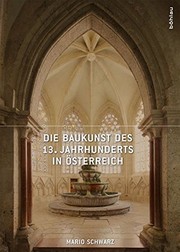
Die Baukunst des 13. Jahrhunderts in Österreich
Mario Schwarz · 2013
על הספר
This book is the first complete description of 13th century architecture in Austria. This period was significant for ist political and historical events and upheavels in the provinces of Austria, but at the same time for the transition from romanic to gothic style. The book is the result of the author's continuous studies in this field of architectural history for more than 35 years. Basing on his doctoral thesis of 1975 the author is outlining a completely new panorama of the development in 13th century architecture by using the results of recent investigations, reconstructions and newly interpreted historical sources. Some important results were achieved on behalf of FWF-projects under the author's direction (reconstruction of the Capella Speciosa at Klosterneuburg, research on the history of the Imperial Palace di Vienna). The results are corresponding in perfect way with the scientifical researches in neighbouring countries as Czech Republic, Hungary, Slovenia and Germany, in regard of the long range cultural communications during the Middle Ages, which in former theories were denied by presupposing a distinct stylistic retard in Austrian architecture. Highly important was the author's proof that in the 13th century in Austria existed a contemporaneity between advanced and retarded stylistic forms. The choice of the stylistic attitude mainly depended on the client. The introduction of the book gives a survey of the actual state of research, followed by three chapters, which explicate the conditions in the 12th century, differentiated geographically (alpine regions, Danube valley) and concerning the clientage (dukes, archbishops and bishops of Salzburg and Passau) as well. By this way the general tendencies and motives (Cistercian architecture of Heiligenkreuz and Zwettl; Patavian architecture at Göttweig, Kremsmünster, Vienna, St.Pölten, Tulln; architecture at Salzburg - cathedral of archbisphop Konrad III - Gurk, Seckau, Hartberg) are outlined, which dominated the further development. In the following first main part, which is describing the first half of 13th century, the important role of the Austrian sovereigns (duke Leopold VI and duke Friedrich II) as founders and benefactors of eminent church architecture is emphasized. With these works of art most actual influences of french gothic architecture came to Austria (Capella Speciosa at Klosterneuburg, cloisters at Lilienfeld and Heiligenkreuz). The quarrel in ecclesiastical policy between the Babenb
פרטי הספר
- שנה
- 2013
- שפה
- German
- הוצאה
- Bohlau Verlag
- מהדורות
- 1
- ISBN
- 9783205789697
מקור הנתונים: Wikidata
עוד של Mario Schwarz