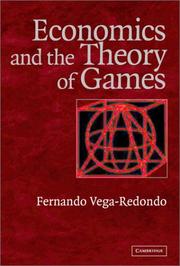
Economics and the Theory of Games
Fernando Vega-Redondo · 2003
על הספר
This textbook offers a systematic, self-contained account of the main contributions of modern game theory and its applications to economics. Starting with a detailed description of how to model strategic situations, the discussion proceeds by studying basic solution concepts, their main refinements, games played under incomplete information, and repeated games. For each of these theoretical developments, there is a companion set of applications that cover the most representative instances of game-theoretic analysis in economics, e.g. oligopolistic competition, public goods, coordination failures, bargaining, insurance markets, implementation theory, signaling and auctions. The theory and applications covered in the first part of the book fall under the so-called 'classical' approach to game theory, which is founded on the paradigm of players' unlimited rationality. The second part shifts towards topics that no longer abide by that paradigm. This leads to the study of topics such as the interplay between evolution and rationality.
המשפט הראשון: In ordinary language, we speak of a "game" as a (generally amusing) process of interaction that involves a given population of individuals, is subject to some fixed rules, and has a prespecified collection of payoffs associated to every possible outcome.
פרטי הספר
- שנה
- 2003
- שפה
- English
- הוצאה
- Cambridge University Press
- מהדורות
- 5
- עמודים
- 524
- ISBN
- 9780521775908
מקור הנתונים: Wikidata