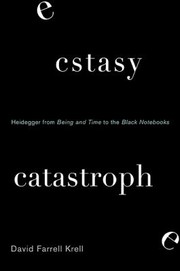
Ecstasy, catastrophe
David Farrell Krell · 2016
איפה לקנות
בדקו את המחיר העדכני באמזון. אנחנו לא מציגים מחירים כי הם משתנים מדי יום.
לצפייה באמזוןקישור שותפים. בתור שותפים של Amazon אנחנו מרוויחים מרכישות מתאימות.
על הספר
In Ecstasy, Catastrophe, David Farrell Krell provides insight into two areas of Heidegger's thought: his analysis of ecstatic temporality in Being and Time (1927) and his "political" remarks in the recently published Black Notebooks (1931-1941). The first part of Krell's book focuses on Heidegger's interpretation of time, which Krell takes to be one of Heidegger's greatest philosophical achievements. In addition to providing detailed commentary on ecstatic temporality, Krell considers Derrida's analysis of ekstasis in his first seminar on Heidegger, taught in Paris in 1964-1965. Krell also relates ecstatic temporality to the work of other philosophers, including Aristotle, Augustine, Kant, Schelling, Hölderlin, and Merleau-Ponty; he then analyzes Dasein as infant and child, relating ecstatic temporality to the "mirror stage" theory as Jacques Lacan. The second part of the book turns to Heidegger's Black Notebooks, which have received a great deal of critical attention in the press and in philosophical circles. Notorious for their pejorative references to Jews and Jewish culture, the Notebooks exhibit a level of polemic throughout that Krell takes to be catastrophic in and for Heidegger's thought. Heidegger's legacy therefore seems to be split between the best and worst of thinking - somewhere between ecstasy and catastrophe. -- from dust jacket.
פרטי הספר
- שנה
- 2016
- שפה
- English
- הוצאה
- State University of New York Press
- מהדורות
- 3
- ISBN
- 9781438458267
מקור הנתונים: Wikidata
עוד של David Farrell Krell