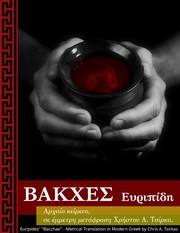
«Βάκχες» Ευριπίδη (Euripides' "Bacchae") Original text in Classical Attic verse, with Prologue, Metrical Translation, Notes & Commentary in Modern Greek
Chris Tsirkas · 2021
על הספר
Free e-book, available at: • Google Books, by ISBN search: 9781456637354 without an ISBN (distributed by me): • My Academia Profile, in PDF format. The god Dionysus —son of Zeus and of the mortal woman Semele— arrives in the city of Thebes from Asia, impersonating a mortal and accompanied by the "Bacchae", his female followers. The latter, clad in deer skins and holding in their hands the "thyrsus" (a wooden staff wrapped in ivy, the symbol and the carrier of the divine power of Dionysus), experience the ecstasy by participating in the sacred mysteries of the god Dionysus, while being at the same time in a state of divine madness —after having freed their mind from the worldly bonds and rules, united in one body and one soul; their body pulsating in the rhythm of the drums, and vibrating to the sweet warbling of the Phrygian flutes. The purpose of Dionysus is to initiate Thebes, his natal city, first among all of Greece, in his new liberating cult. In his last work, the "Bacchae", Euripides introduces novelties in the epistemology of the Attic Tragedy as well as in the structure of its theatrical representation; at the same time, he tries to introduce these novelties in the way of perception and thinking of the spectators (perhaps, more in an effort to warn them, rather than to reform their mindset). The "Bacchae" can be considered more as a cultural cry of agony as well as a poetic protest against the looming end of the Attic Tragedy itself, the end of the Athenian democracy and the end of the classical Hellenism, and less as a purely didactic content which aims at the intellectual self-improvement of the spectators. Euripides brutally modernizes and reconstructs the mechanisms of the theatrical receptivity (and, in part, of the aesthetics) of the ancient Attic Tragedy; he "abolishes" it as a distinct kind of poetic and theatrical creation, and "buries" it (perhaps anticipating its possible rebirth in the future, in a manner similar to the double birth of Dionysus, the creator of the theater), shortly before he himself dies, in a manner similar to that of the protagonist of the drama. This book includes the original (partially reconstructed) ancient text of the "Bacchae", translated side-by-side in modern greek, in verse. The translation is accompanied by commentary on a selected number of verses, and by an extensive Prologue (both in modern greek) —in which the "Bacchae" and its contents are analyzed, including a composite interpretive view of the traged
פרטי הספר
- שנה
- 2021
- שפה
- Greek
- הוצאה
- eBookit.com
- מהדורות
- 1
- ISBN
- 9781456637354
מקור הנתונים: Wikidata
עוד של Chris Tsirkas