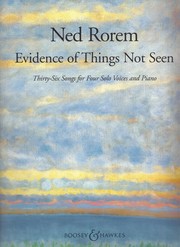
Evidence of Things Not Seen
Ned Rorem · 1999
על הספר
In plotting the format of the present work, composed mostly in 1997, I chose 36 texts by 24 authors. Wystan Auden, Paul Goodman (a childhood idol), and Walt Whitman, all of whom I had used dozens of times before, are here represented by five, four, and three poems each. William Penn, who, as we Quakers say, speaks to my condition, is represented by two prose selections, as are Stephen Crane and the eighteenth-century hymnodist Thomas Ken. The other eighteen authors provide one song each. The sendoff by Roethke, "From Whence Cometh Song," I used once before in another version, and would not have set it again, but no other poem seemed more apt. The verses of Wordsworth, Browning, and Elizabeth Barrett, though world famous, are new to my pen. Edna Millay, another childhood idol, remains close to my heart. Like Penn, John Woolman was a Quaker thinker whose prose dates from the early 1700s; his pacifism, like that of the more ironic Langston Hughes, contrasts with the sometimes warlike Kipling. Kipling's contemporary countrymen, Oscar Wilde and A. E. Housman, with their Victorian poignancy, contrast in turn with the American poignancy of the very late Jane Kenyon. The prose passages from the French of Colette and of Julien Green are, in my translation, the final paragraphs respectively of their semi-autobiographical works, L'autre sommeil and L'Etoile vesper. Robert Frost, along with Dickinson and Whitman, is probably the American poet most often used by musicians; his elegiac "Come In" fits perfectly here. So does Baudelaire's English verse, and that of Yeats, which is arranged for trio. Mark Doty's weighty harangue, "Faith," from his Atlantis, specifically concerns the tragedy of AIDS, as does the penultimate song, drawn from the late Paul Monette's Love Alone. Two of the songs, Green's "He Thinks Upon His Death" and Goodman's "Boy with a Baseball Glove," were composed 45 years ago, and have waited all this time to find a home. (In 1984, I did reshape the Goodman song, minus the words, into the third movement of a Violin Concerto.) Mark Doty still thrives in Provincetown. I have personally known six of them, though none, I think, have known each other; the interrelationship depends solely on my whimsical juxtapositions, as does their continuity within the cycle. The order of songs relies on subject matter. The opening group, Beginnings, is just that--songs about moving forward, and the wistful optimism of love, with a concluding hymn-text from the eighteenth
פרטי הספר
- שנה
- 1999
- שפה
- English
- הוצאה
- Boosey & Hawkes
- מהדורות
- 1
- ISBN
- 0073999085136
מקור הנתונים: Wikidata
עוד של Ned Rorem