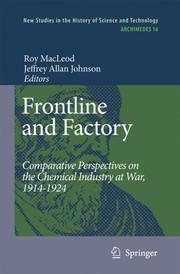
Frontline and factory
Jeffrey Allan Johnson, Roy M. MacLeod · 2007
איפה לקנות
המחיר באמזון משתנה מדי יום, אז הכי נכון לראות אותו שם ברגע הקנייה.
לצפייה באמזוןזה קישור שותפים: כשקונים דרכו, האתר מקבל עמלה קטנה בלי תוספת במחיר עבורכם, וזה עוזר לנו להביא תוכן איכותי ולתחזק את האתר. בתור שותפים של Amazon אנחנו מרוויחים מרכישות מתאימות.
על הספר
The First World War is often called the ‘chemists’ war’. But few realise precisely how, or the extent to which modern chemistry became a significant factor in the struggle, and would be in turn deeply shaped by it. Gathering momentum at first, by 1916, success in applying scientific knowledge to ‘frontline and factory’ became a measure of a nation’s capacity to win an industrial war. In the end, the titanic contest was won in large part through the command of raw materials and industrial output. This book represents a first considered attempt to study the factors that conditioned industrial chemistry for war in1914-18. Taking a comparative perspective, it reflects on the experience of France, Germany, Austria, Russia, Britain, Italy and Russia, and points to significant similarities and differences. It looks at changing patterns in the organisation of industry, and at the emerging symbiosis between science, industry and the military, which contributed to the first ‘academic-military-industrial’ complex of the 20th century. At the same time, it reflects on the world’s first, and ultimately unsuccessful attempt to monitor ‘dual-use’ chemical technologies, and so restrict the proliferation of an important category of weapons of mass destruction.
פרטי הספר
- שנה
- 2007
- שפה
- English
- הוצאה
- Springer
- מהדורות
- 3
- עמודים
- 300
- ISBN
- 9781402054891
מקור הנתונים: Wikidata