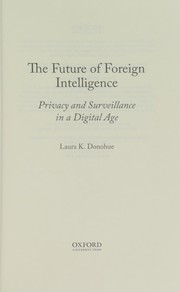
Future of Foreign Intelligence
Laura K. Donohue · 2016
איפה לקנות
בדקו את המחיר העדכני באמזון. אנחנו לא מציגים מחירים כי הם משתנים מדי יום.
לצפייה באמזוןקישור שותפים. בתור שותפים של Amazon אנחנו מרוויחים מרכישות מתאימות.
על הספר
"Since the nations’ founding, America’s leaders have recognized that national security depends upon the collection of intelligence. The legislature and the courts have thus given the executive branch a wide berth to determine how best to obtain and use foreign intelligence. At times, the executive has so aggressively pursued its course that it has run afoul of the Constitution. At such junctures, Congress and the courts have sought to bring it back into line. In the 1970s, the Foreign Intelligence Surveillance Act represented one such moment. The law provided the President with enough authority to deter external attack and to ensure domestic security, while protecting individual rights. The courts subsequently considered the legislation to be a Constitutional limit on executive power. For nearly three decades, the equilibrium held. But … the 9/11 attacks radically shifted the landscape. The executive branch immediately took advantage of new and emerging technologies, bypassing the statutory realm altogether. In the process, it ran roughshod over important limits that the founding generation, for good reason, cemented into the Fourth Amendment. Later efforts to shoehorn surveillance programs into the statutory framework led to a contorted reading of the law—one hidden from public view until a series of leaks forced the information into the public domain. Individual liberty is now on the line. General warrants, rejected by the Framing generation, are beginning to reappear. Important legal doctrines have yet to recognize the privacy interests at stake in electronic communications. And the convergence between national security and law enforcement means that weaker foreign intelligence standards are being used in ordinary criminal prosecution. At risk is the right to privacy and the balance of power in the United States. The stakes could not be higher as we enter the digital age." -- Book jacket. "Since the Revolutionary War, America's military and political leaders have recognized that U.S. national security depends upon the collection of intelligence. Absent information about foreign threats, the thinking went, the country and its citizens stood in great peril. To address this, the Courts and Congress have historically given the President broad leeway to obtain foreign intelligence. But in order to find information about an individual in the United States, the executive branch had to demonstrate that the person was an agent of a foreign power. Today, that bar
פרטי הספר
- שנה
- 2016
- שפה
- English
- הוצאה
- Oxford University Press, Incorporated
- מהדורות
- 1
- עמודים
- 224
- ISBN
- 9780190235383
מקור הנתונים: Wikidata
עוד של Laura K. Donohue