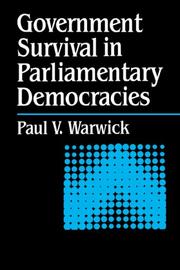
Government Survival in Parliamentary Democracies
Paul Warwick · 1994
על הספר
Why do some parliamentary democracies, such as Britain, manage to produce highly durable governments, whereas others, such as Italy, are marked by instability? While Britain's "Westminster model" garners public confidence in and respect for the model, the contrasting record of what is essentially the same regime model in Italy more often elicits criticism and ridicule. Through a wide-ranging quantitative investigation, this book seeks to unravel the puzzling, Janus-faced nature of parliamentary democracy and answer a central question of contemporary political science: what determines how long governments survive in parliamentary democracies? Government survival is important because it constitutes an essential component of the overall functioning of parliamentary democracies. It is also closely associated with the introduction to the discipline of event history analysis, a highly promising statistical methodology. The investigation utilizes this methodology on the most comprehensive data set yet assembled on governments, comprising hundreds of variables measured for sixteen West European parliamentary democracies over the entire postwar period to 1989. The results fundamentally challenge the central thread of current theorizing on government survival and point to an alternative conceptualization of the relationship among governments, parties, and voters. Within this rich statistical portrait the author attempts, ultimately, to account for the two faces of parliamentary government.
המשפט הראשון: The liberal democratic world is composed for the most part of two very different regime types: the presidential and the parliamentary.
פרטי הספר
- שנה
- 1994
- שפה
- English
- הוצאה
- Cambridge University Press
- מהדורות
- 1
- עמודים
- 200
- ISBN
- 9780521038317
מקור הנתונים: Wikidata