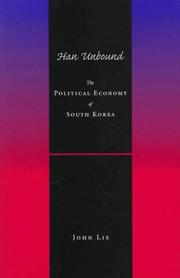
Han Unbound
John Lie · 1998
איפה לקנות
בדקו את המחיר העדכני באמזון. אנחנו לא מציגים מחירים כי הם משתנים מדי יום.
לצפייה באמזוןקישור שותפים. בתור שותפים של Amazon אנחנו מרוויחים מרכישות מתאימות.
על הספר
This book reveals how South Korea was transformed from one of the poorest and most agrarian countries in the world in the 1950's to one of the richest and most industrialized states by the late 1980's. The author argues that South Korea's economic, cultural, and political development was the product of a unique set of historical circumstances that cannot be replicated elsewhere, and that only by ignoring the costs and negative consequences of development can South Korea's transformation be described as an unqualified success. The historical circumstances include a thoroughgoing land reform that forced children of former landlords to move to the cities to make their fortunes, a very low-paid labor force, and the threat from North Korea and the consequent American presence. The costs of development included the exploitation of labor (as late as 1986, South Korean factory workers had the longest hours in the world and earned less than their counterparts in Mexico and Brazil), undemocratic politics, and despoliation of the environment. Because the author sees South Korean development as contingent on a variety of particular circumstances, he ranges widely to include not only the information typically gathered by sociologists and political economists, but also insights gained from examining popular tastes and values, poetry, fiction, and ethnography, showing how all of these aspects of South Korean life help elucidate his main themes.
המשפט הראשון: The yangban (the landed gentry) dominated Choson Dynasty Korea (1392-1910) and retained their local power during the Japanese colonial period (1910-45).
פרטי הספר
- שנה
- 1998
- שפה
- English
- הוצאה
- Stanford University Press
- מהדורות
- 2
- עמודים
- 276
- ISBN
- 9780804740159
מקור הנתונים: Wikidata
עוד של John Lie