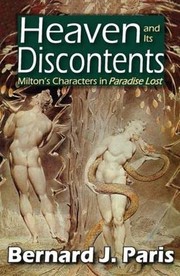
Heaven and its discontents
Paris, Bernard J. · 2010
על הספר
"There is a tradition of little books that make a huge difference in how we read Paradise Lost, and Bernard J. Paris's Heaven and Its Discontents is a worthy member of this group. Rather than looking at Adam, Eve, God, and Satan in purely doctrinal or theological terms, Paris insists that we read Milton's creations as characters whose inner conflicts drive the story. His analysis of how God's and Satan's rivalry and psychological conflicts drives the story is revelatory. Milton's critics will profit from how the brilliant, short book continues the project of the New Milton Criticism, and students will find Heaven and Its Discontents an extremely helpful entree into Paradise Lost. Highly recommended for beginners and experts alike."--Peter C. Herman, professor of English Literature, San Diego State University; author of Destabilizing Milton: "Paradise Lost" and the Poetics of Incertitude. The enduring appeal of Shakespeare's works derives Iargely from the fact that they contain brilliantly drawn characters. Interpretations of these characters are products of changing modes of thought, and thus past explanations of their behavior, including Shakespeare's, no longer satisfy us. In this work, Bernard J. Paris shows how Shakespeare endowed his tragic heroes with enduring human qualities that have made them relevant to people of later eras. The author's combination of literary and psychoanalytic perspectives guides us to a humane understanding of Shakespeare and his protagonists, and, in turn, to a more profound knowledge of human behavior. Andre Gide once said that Feodor Dostoevsky "lost himself in the characters of his books, and, for this reason, it is in them that he can be found again." In this book, Louis Breger approaches Dostoevsky psychoanalytically, not as a "patient" to be analyzed, but as a fellow psychoanalyst, someone whose life and fiction are intertwined in the process of literary self-exploration. Many critics agree with C. S. Lewis that "Satan is the best drawn of Milton's characters." Satan is certainly a wonderful creation, but Adam and Eve are also complex and well-drawn, and God may be the most complicated character of all. Paradise Lost is above all God's story; it is his discontent, first with Lucifer and then with human beings, that drives the action from the beginning until his anger subsides at the world's end. God and Satan have similarities not only in their pursuit of revenge, but also in their craving for power and glory. The ambi
פרטי הספר
- שנה
- 2010
- שפה
- English
- הוצאה
- Transaction Publishers
- מהדורות
- 6
- עמודים
- 146
- ISBN
- 9781412810913
מקור הנתונים: Wikidata
עוד של Paris, Bernard J.