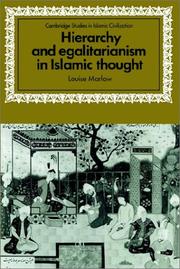
Hierarchy and Egalitarianism in Islamic Thought (Cambridge Studies in Islamic Civilization)
Louise Marlow · 2002
על הספר
By bringing together and examining a diverse body of literature from the Arab and Persian worlds of the eighth to the thirteenth centuries, Louise Marlow explores the tension that existed between the traditional egalitarian ideas of early Islam and the hierarchical impulses of the classical period. The literature demonstrates that while Islam's initial orientation was markedly egalitarian in both religious and social terms, the social aspect of this egalitarianism was soon undermined in the aftermath of Islam's political success, and as hierarchical social ideas from older cultures in the Middle East were incorporated into the new polity. Although the memory of its early promise never entirely receded and remnants of the ideal survive in many parts of the tradition, social egalitarianism quickly came to be associated with political subversion and various attempts were made to dilute its influence. On account of its originality and chronological scope, Louise Marlow's book will be of use to a wide and interested readership, not only of Islamic and medieval historians, but also of scholars assessing the impact of the recent Islamic revival.
המשפט הראשון: The main emphasis of this chapter is on the assorted dicta that, according to authors of the classical period, represent the literary remains of the first century or so.
פרטי הספר
- שנה
- 2002
- שפה
- English
- הוצאה
- Cambridge University Press
- מהדורות
- 1
- עמודים
- 214
- ISBN
- 9780521894289
מקור הנתונים: Wikidata
עוד של Louise Marlow