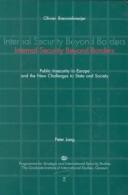
Internal Security Beyond Borders
Olivier Brenninkmeijer · 2001
איפה לקנות
בדקו את המחיר העדכני באמזון. אנחנו לא מציגים מחירים כי הם משתנים מדי יום.
לצפייה באמזוןקישור שותפים. בתור שותפים של Amazon אנחנו מרוויחים מרכישות מתאימות.
על הספר
CRITICAL REVIEW OF: Internal Security Beyond Borders Reviewed By: Simon Duke PhD Reviewed in: Journal of Contingencies and Crisis Management Date accepted online: 11/01/2005 Published in print: Volume 12, Issue 3, Pages 128-135. FULL TEXT OF REVIEW BELOW: At the time of writing Internal Security Beyond Borders Brenninkmeijer was a PhD candidate at the Graduate Institute of International Studies, Geneva. As the title suggests, the book starts with the assumption that internal security is an issue that can rarely be addresses solely in the national context since the existence of trans-national crime, fostered by modern communication, transport and 'globalisation' (a phenomenon that applies to criminal activity just as much as any other aspect) gives both perceptions of security and actual responses to security challenges regional and international dimensions. This means, as he makes clear with Switzerland as a case study, that addressing internal security is a matter of cooperation at a variety of levels, including those beyond borders. Brenninkmeijer usefully distinguishes between 'subjective' feelings of security, which may be manifest in feelings of public discomfort in open spaces, lack of faith in the police and law and order establishments, and in some cases the desire for isolation at individual, group or national levels. This is contrasted with 'objective' security which stems from real, or measurable, criminal and other illegal activity. This leads to tension between the expectations we have from our governments for security and the life-style we choose (i.e. maximum personal freedoms). Brenninkmeijer observes that such tension could lead to a vicious circle whereby the desire for security and feelings of insecurity become synonymous and, thus, self-defeating. His task of addressing perceptions of security with 'objective' facts relating to internal security is complicated by the fact that crime statistics, media articles or other official figures do not convey an accurate impression of safety in society. The statistics nevertheless point at some general (if rather unsurprising) conclusions such as the existence of a correlation between deviant and offending behaviour and economic and social factors; that most minor aggressions are not reflected in official statistics; or that small offences (vandalism, offensive or reckless behaviour) are most likely to lead to feelings of insecurity. Brenninkmeijer continues the theme of 'subjective' and 'objectiv
פרטי הספר
- שנה
- 2001
- שפה
- English
- הוצאה
- Peter Lang Publishing
- מהדורות
- 2
- עמודים
- 217
- ISBN
- 9780820453026
מקור הנתונים: Wikidata