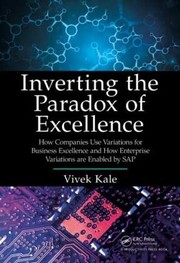
Inverting the paradox of excellence
Vivek Kale · 2014
על הספר
"Taking inspiration from one of the best models of success, the evolutionary model, Inverting the Paradox of Excellence explains why companies should actively seek out changes or variations on a regular basis. Presenting an introduction to the patterns and anti-patterns of excellence, it includes detailed case studies based on different variations including, structure variations, shared values variations, and staff variations.This book presents various dimensions of business variations that are available for any company to explore in its continual quest for opportunities to achieve and sustain excellence. As long as it collectively and effectively covers the various aspects of an operational company, the exact set of the chosen dimensions of variations is immaterial. This book chooses and extends a set inspired originally by In Search of Excellence (as a tribute to its pioneering effort in focusing interest on the challenges of sustaining excellence in enterprise performance), namely, shared values, strategy, structure, stuff, style, staff, skills, systems and sequence.Instead of newer case studies, the book presents the usual and long familiar case studies through the prism of the 'variations' idea to experience the difference of the 'case history' approach presented here. The book includes case history segments for Toyota, Acer, eBay, ABB, Cisco, Blackberry, Tata, Samsung, Volvo, Charles Schwab, McDonald, Scania, Starbucks, Google, Disney, NUMMI and others. It has detailed case histories of three companies GE, IBM and UPS. At industry-level, the book focuses on the Automobile industry because it has been widely witnessed and participated by everyone across the world in the last century"-- "Preface In Search of Excellence started a trend of comprehensive efforts worldwide to identify the prescriptive characteristics for excellent companies. However, time and again, corrective measures adopted by companies, based on such prescriptions, have belied expectations. An analysis of Fortune 1000 corporations shows that between 1973 and 1983, 35% of the top 20 companies are new. The number of new companies rises to 45% when the comparison is between 1983 and 1993. It increases even further, to 60%, when the comparison is between 1993 and 2003. It seems that the very strategies that contribute to the competitiveness, success, and excellence of an enterprise, in time, lead to its decline resulting from organizational inertia, complacence, and inflexibility because o
פרטי הספר
- שנה
- 2014
- שפה
- English
- הוצאה
- Taylor & Francis
- מהדורות
- 4
- עמודים
- 418
- ISBN
- 9781466592162
מקור הנתונים: Wikidata
עוד של Vivek Kale