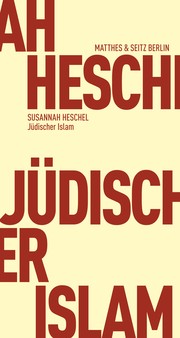
Islam and Jewish-German Self-Understanding
Susannah Heschel · 2018
על הספר
Why were so many European Jewish scholars drawn to the study of Islam? From the 1830s to the 1930s, Jewish scholars began studying the Qur’an, writing scholarly books and articles about the origins of Islam, the life of the prophet Muhammad, and even published translations of the Qur’an into German, French, and Hebrew. These scholars, primarily in Germany, Hungary, and France, painted a broad canvas describing the nature of Islam very sympathetically. Initially, scholars presented Islam as derived from Judaism, and under whose aegis, especially in medieval Muslim Spain, Jews enjoyed not only religious tolerance, but cultural and economic flourishing. Jewish historians wrote of a “Golden Age” of Muslim Spain, in which exchange of ideas between Muslims and Jews led to an intellectual renaissance. They compared Islam’s religious tolerance with Christianity’s intolerance, describing the blossoming of Jewish religious thought, philosophy, and poetry under Islam with the persecution Jews experienced in medieval Christian Europe. Jewish scholarship on Islam was translated by popular writers and theologians to a broad readership, and Moorish architecture of synagogues also signified a Jewish identification with Islam. In the long nineteenth century, Islam came to play an important role in Jewish self-definition, as the religion closest to Judaism, even as a model of enlightened religion to which Judaism might aspire. Jewish scholarship on Islam began with Abraham Geiger’s 1833 book, What Did Muhammad Take from Judaism?, Gustav Weil’s 1843 biography of the prophet Muhammad, Ludwig Ullmann’s 1840 German translation of the Qur’an, Herman Reckendorff’s 1857 Hebrew translation, Ignaz Goldziher’s monumental studies of the Hadith, and the innumerable works comparing rabbinic commentaries with the Qur’an published by Jewish scholars from the 1830s onward. Some Jewish scholars traveled to Muslim countries, some converted, and several left important footprints in Islamic scholarship and culture. For example, Gottlieb Leitner helped establish the University of the Punjab in Lahore, where he lived during the 1860s and 70s, and wrote several books in Urdu on the history of Islam, before returning to England, where he built the first mosque and institute for the study of Arabic. Josef Horovitz served as Professor of Arabic from 1907 to 1914 at the Mohammedan Anglo-Oriental College, later known as the Aligarh Muslim University. By the 1920s and 30s, Jews played a central role in
פרטי הספר
- שנה
- 2018
- שפה
- German
- סדרה
- Fröhliche Wissenschaft, 106; Schriftenreihe des Forum Transregionale Studien
- הוצאה
- Matthes & Seitz Berlin
- מהדורות
- 1
- עמודים
- 153
- ISBN
- 9783957573414
מקור הנתונים: Wikidata