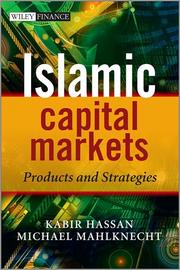
ISLAMIC CAPITAL MARKETS
Kabir Hassan · 2011
על הספר
"The standardization of Islamic financial products is currently evolving, both for Islamic derivatives & hedging methods and for Islamic bonds (Sukuk) and the process of standardization is expected to start soon also for other Islamic instruments. Islamic capital markets, and Islamic finance in general, is experiencing global rapid growth and is currently receiving more consideration also by non-Islamic investors. Islamic Finance is based on the prohibition of interest ("Riba"), excessive uncertaintly ("Gharar") and gambling ("Maysir" or "Qimar"). From these foundations, conventional financial products, such as interest-bearing instruments, options, forwards, futures, and insurances, as well as conventional practices like short-selling and leveraging, are not compliant with Islamic law ("Shariah"). Nevertheless, the Islamic finance industry has undertaken considerable efforts to create products and solutions of the same value, in many instances by replicating conventional structures in a Shariah-compliant manner. This has led to discussions between scholars and practitioners, as some scholars regard specific replication techniques merely as ploys and ruses. While no definite answer can be given yet concerning the question of Shariah-compliance for every single instrument, some trends are emerging in this dynamic market. Islamic derivative products are essential for asset management and risk management in any Islamic context, and provide answers to many of the investors' needs. This book covers all Islamic derivatives and structured products including state of the art Islamic short-selling methods used by hedge funds and gives a comprehensive overview of current Islamic capital markets. It takes a practical approach addressing practical issues in risk management and investing for both Islamic and non-Islamic readers. .Contents A. Introduction B. Islamic capital market instruments 1. Hedging and Islamic derivatives (explaining many de facto practices used by Islamic financial institutions, and potential future applications not yet broadly applied; standardization and financial engineering) 2. Sukuk (Islamic bonds, current trends and issues in the market, standardization etc.) 3. Islamic funds (incl. specific hedge-fund practices, Islamic REITs, Islamic Private Equity funds, brief overview on market indices) 4. Islamic structured products (all currently existing types of Shariah-compliant structuring principles, example products, etc.) C. Islamic risk managem
פרטי הספר
- שנה
- 2011
- שפה
- English
- הוצאה
- John Wiley & Sons
- מהדורות
- 7
- עמודים
- 480
- ISBN
- 9780470689578
מקור הנתונים: Wikidata
עוד של Kabir Hassan