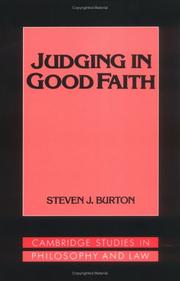
Judging in Good Faith (Cambridge Studies in Philosophy and Law)
Steven J. Burton · 1994
על הספר
"This book is concerned with the ethics of judging in courts of law. Professor Burton analyzes the grounds, content, and force of a judge's legal and moral duties to uphold the law. He defends two primary theses. The first is the good faith thesis, whereby judges are bound in law to uphold the law, even when they have discretion, by acting only on reasons warranted by the conventional law as grounds for judical decisions. The good faith thesis counters the common view that judges are not bound by the law when they exercise discretion. The second is the permissible discretion thesis, whereby, when exercised in good faith, judicial discretion is compatible with the legitimacy of adjudication in a constitutional democracy under the Rule of Law. The permissible discretion thesis counters the view that judges can fulfill their duty to uphold the law only when the law yields determinate results." "Together, these two theses provide an original and powerful theory of adjudication in sharp contrast both to conservative theories that would restrict the scope of adjudication unduly, and to leftist critical theories that would liberate judges from the Rule of Law."--BOOK JACKET.
המשפט הראשון: The problem of legal indeterminacy has moved to the center of jurisprudential debate in the United States since Oliver Wendell Holmes, Jr., proclaimed: The life of the law has not been logic: it has been experience.
פרטי הספר
- שנה
- 1994
- שפה
- English
- הוצאה
- Cambridge University Press
- מהדורות
- 1
- עמודים
- 291
- ISBN
- 9780521477406
מקור הנתונים: Wikidata
עוד של Steven J. Burton