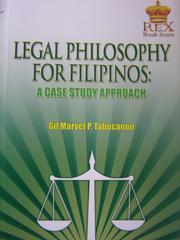
Legal Philosophy for Filipinos
Gil Marvel P. Tabucanon · 2011
על הספר
Yesterday, I received the complimentary copies of my book published by Rex Bookstore in Manila entitled Legal Philosophy for Filipinos. The book is dedicated to Baha’u’llah, the prophet founder of the Baha’i Faith, who wrote and commented extensively on global justice, the idea being that mankind has reached a point of maturity enough for it to accept and realize the concept of ‘oneness of mankind’ and the ‘fundamental unity of all the religions.’ But going back to legal philosophy let me share the preface I wrote in the book: Legal philosophy is not an easy subject to tackle; for that matter, it is not usually in the law students’ top ten list of favorite subjects. I base these observations from my more than seven years of teaching the course. I will cite three reasons why legal philosophy baffled law students in the past, and continues to do so at present among today’s supposedly cyber-smart students: 1) It is not a bar subject; ergo, it must be a ‘minor’ subject, 2) its study does not help bring in one’s first ‘million,’ and 3) legal philosophy is only for philosophers inhabiting cloistered academic ivory towers. The arguments are misplaced. True, legal philosophy is not a bar subject. But so is legal research, or, strictly, legal writing. All three subjects imbue skills to the bar candidate pervading through in all the eight bar subjects and beyond. Imagine a lawyer who is deficient in legal research: where would he find his law, and decisions to bolster his argument, not to mention citations deconstructing the fallacies of his opponent. Or a practitioner whose writing skills amounts at best to legal mumbo-jumbo, i.e., one who has no clue how to present his thoughts on paper in simple, grammatically correct and clear terms. Legal philosophy equips students with outright skills in questioning, analysis and the ability to look at the facts and law from different viewpoints. The course teaches students how to be broadminded, mindful of the ‘essence’ of the rules rather than merely sticking to their literal signification, for in the end it is the letter that ‘killeth’ and spirit that ‘giveth life’ (2 Cor 3:6). It urges one to introspect, to be critical even of one’s own beliefs, for one is not always right all the time, and truth may come from anyone –friend or foe- regardless of his or her life status: Light is light in whatever lamp it is shining, to paraphrase Abdu’l-Baha. Thus a linear, one-track kind of mind so dangerously expressed in the way some pe
פרטי הספר
- שנה
- 2011
- שפה
- English
- הוצאה
- Published & distributed by Rex Book Store
- מהדורות
- 1
- עמודים
- 209
- ISBN
- 9789712359927
מקור הנתונים: Wikidata