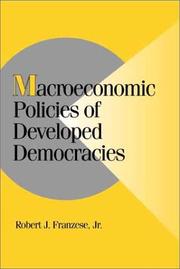
Macroeconomic Policies of Developed Democracies
Jr, Robert J. Franzese · 2002
על הספר
"This book synthesizes and extends modern political-economic theory to show how varying interest and institutional structures and shared exposure to similar economic challenges interact to explain commonalities and divergences in the postwar evolution of macroeconomic policies in developed democracies. Where more participatory institutions enhanced governmental responsiveness to inequality and economic hardship, transfers grew more dramatically. Where more fractionalized governments retarded fiscal-policy adjustment rates, debt responses to spending growth, shocks, and other conditions were greatly magnified. These differently rising costs of transfers and debt spurred anti-inflationary policy shifts that amplified fiscal problems and proved more costly where monetary conservatives confronted less coordinated, public-sector-led rather than more coordinated, traded-sector-led wage-price bargainers. The book shows how such multiple interactions among political-economic institutions and interests induce differing policy choices and effects across democracies; how to model such complexly interactive propositions empirically compactly and substantively revealingly; how such arguments and models explain the evolution of developed democracies' macroeconomic policies from postwar commitments to full employment and social insurance to more recent conservative monetary, fiscal, and other "reforms"; and how political conflicts over such policy and institutional choices always were and still remain primarily about distribution, and only subsidiarily about efficiency, whatever partisan protagonists may claim."--Jacket.
פרטי הספר
- שנה
- 2002
- שפה
- English
- הוצאה
- Cambridge University Press
- מהדורות
- 1
- עמודים
- 332
- ISBN
- 9780521004411
מקור הנתונים: Wikidata