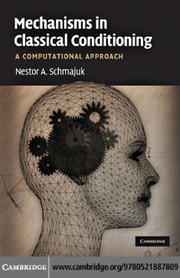
Mechanisms in classical conditioning
Nestor A. Schmajuk · 2010
איפה לקנות
בדקו את המחיר העדכני באמזון. אנחנו לא מציגים מחירים כי הם משתנים מדי יום.
לצפייה באמזוןקישור שותפים. בתור שותפים של Amazon אנחנו מרוויחים מרכישות מתאימות.
על הספר
"What mechanisms are involved in enabling us to generate predictions of what will happen in the near future? Although we use associative mechanisms as the basis to predict future events, such as using cues from our surrounding environment, timing, attentional, and configural mechanisms are also needed to improve this function. Timing mechanisms allow us to determine when those events will take place. Attentional mechanisms ensure that we keep track of cues that are present when unexpected events occur and disregard cues present when everything happens according to our expectations. Configural mechanisms make it possible to combine separate cues into one signal that predicts an event different from that predicted individually by separate cues. Written for graduates and researchers in neuroscience, computer science, biomedical engineering and psychology, the author presents neural network models that incorporate these mechanisms and shows, through computer simulations, how they explain the multiple properties of associative learning"--Provided by publisher. "Part I. Introduction: 1. Classical conditioning: data and theories; Part II. Attentional and Associative Mechanisms: 2. An attentional-associative model of conditioning; 3. Simple and compound conditioning; 4. The neurobiology of classical conditioning; 5. Latent inhibition; 6. The neurobiology of latent inhibition; 7. Creativity; 8. Blocking and overshadowing; 9. Extinction; 10. The neurobiology of extinction; Part III. Configural Mechanisms: 11. A configural model of conditioning; 12. Occasion setting; 13. The neurobiology of occasion setting; Part IV. Attentional, Associative, Configural, and Timing Mechanisms: 14. Configuration and timing: timing and occasion setting; 15. Attention and configuration: extinction cues; 16. Attention, association and configuration: causal learning and inferential reasoning; Part V. Conclusion: Mechanisms of classical conditioning"--Provided by publisher.
פרטי הספר
- שנה
- 2010
- שפה
- English
- הוצאה
- Cambridge University Press
- מהדורות
- 3
- עמודים
- 485
- ISBN
- 9780521887809
מקור הנתונים: Wikidata