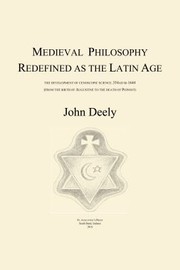
Medieval Philosophy Redefined
John Deely · 2010
איפה לקנות
בדקו את המחיר העדכני באמזון. אנחנו לא מציגים מחירים כי הם משתנים מדי יום.
לצפייה באמזוןקישור שותפים. בתור שותפים של Amazon אנחנו מרוויחים מרכישות מתאימות.
על הספר
Up to now, "medieval philosophy" has suffered from the absence of any positive definition which would give coherence to the period as a whole. The positive terms for a redefining of medieval thought, as accomplished in this book, result from developing the neglected but intertwined consequences of two simple facts. The first is the fact, generally recognized, that from its beginning in the lifetime of Augustine to its demise in the lifetime of Galileo, Poinsot, and Descartes (when transition was made to our national languages), intellectual life was communicated principally in the Latin language. The second is the fact, unnoticed by the principal historians of philosophy (and medieval philosophy in particular from the late 19th to the end of the 20th century), that the general notion of sign as a reality upon the action of which depends the whole of human knowledge, including science in the modern sense, was an original initiative of Latin thought--an idea without counterpart in the ancient Greek period of philosophy's first development. The general notion of sign, in fact, was first introduced into human thought in a thematic way by Augustine of Hippo, coincidentally the first major thinker to write exclusively in Latin ignorant of Greek. After Augustine, his notion of sign everywhere pervaded the culture of Latin thought; but only after the 12th century advent of Aristotle did thinkers begin, in the lifetime of Thomas Aquinas, to focus on inquiry into and development of this notion of the being and action of signs as the constant underlay in the development of human thought. Once begun, however, this investigation led to a growing realization that the action of signs ("semiosis", as it came to be called in postmodern intellectual culture) lay behind and within the development of nature itself. Semiosis proves to be an "influence of the future", transforming environmental conditions gradually, indeed, but dramatically enough that, over time, from an originally lifeless universe, life and eventually human life could emerge and develop. These two facts taken together -- the general notion of sign as the original initiative of Latin thought, and the use of the Latin language as the principal instrument for the development of speculative (i.e., species-specifically human) thought -- allow us for the first time to see the "medieval period" as a positively unified whole. This period forms truly and integrally the middle ages, the whole span between the end of a
פרטי הספר
- שנה
- 2010
- שפה
- English
- הוצאה
- University of Scranton Press
- מהדורות
- 1
- עמודים
- 507
- ISBN
- 9781589662162
מקור הנתונים: Wikidata
עוד של John Deely