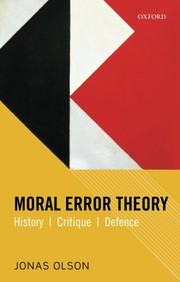
Moral Error Theory
Jonas Olson · 2014
איפה לקנות
בדקו את המחיר העדכני באמזון. אנחנו לא מציגים מחירים כי הם משתנים מדי יום.
לצפייה באמזוןקישור שותפים. בתור שותפים של Amazon אנחנו מרוויחים מרכישות מתאימות.
על הספר
Jonas Olson presents an original account of the historical background of moral error theory, and examines in particular J.L. Mackie's influential contributions to the debate. In Part I (History), Olson provides the historical context of the debate, and discusses the moral error theories of David Hume and some of the more or less influential twentieth century philosophers, including Axel Hägerström, Bertrand Russell, Ludwig Wittgenstein, and Richard Robinson. He argues that the early cases for moral error theory are suggestive but that they would have been stronger had they included something like Mackie's arguments that moral properties and facts are metaphysically queer. Part II (Critique) focuses on these arguments. Olson identifies four queerness arguments, concerning supervenience, knowledge, motivation, and irreducible normativity, and goes on to establish that while the first three are not compelling, the fourth has considerable force, especially when combined with debunking explanations of why we tend to believe that there are moral properties and facts when in fact there are none. One conclusion of Part II is that a plausible error theory takes he form of an error theory about irreducible normativity. In Part III (Defense), Olson considers challenges according to which that kind of error theory has problematic ramifications regarding hypothetical reasons, epistemic reasons, and deliberation. He ends his discussion with a consideration of the upshots of moral error theory for ordinary moral thought and talk, and for normative theorizing. -- Book jacket.
פרטי הספר
- שנה
- 2014
- שפה
- English
- הוצאה
- Oxford University Press
- מהדורות
- 6
- עמודים
- 224
- ISBN
- 9780198701934
מקור הנתונים: Wikidata