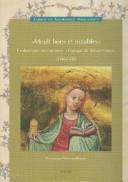
"Moult bons et notables"
איפה לקנות
בדקו את המחיר העדכני באמזון. אנחנו לא מציגים מחירים כי הם משתנים מדי יום.
לצפייה באמזוןקישור שותפים. בתור שותפים של Amazon אנחנו מרוויחים מרכישות מתאימות.
על הספר
This study is the first to systematically examine the production of illuminated manuscripts in Tournai from 1380 to 1430, a period in which the city played a key role in the history of western painting. It was during these crucial years that the Tournai painter Robert Campin revolutionised courtly painting and established, along with Jan van Eyck, the foundations of the northern Renaissance. Whilst the panel paintings associated with Campin have been the subject of numerous studies, manuscript illumination, by contrast, has remained the poor relation in historiographic terms. Clearly, the impassioned debate surrounding the personality of Robert Campin, alias ‘the Master of Flémalle’, has largely eclipsed this entire aspect of the history of Tournaisian art. However, it is apparent from archival sources that illuminators were active in Tournai during the fifteenth century and that their craft was subordinated to that of the painters. Moreover, a recently discovered document has shown that Campin himself made or had miniatures made. However, despite these proven links, no systematic study has yet examined manuscript production at the time of the Tournaisian master, even though, through ‘stealthy approaches on the side’, it might potentially shed light on his still controversial oeuvre. The present study seeks to redress this neglect. An important group of about thirty manuscripts, mostly little known, has been assembled around a missal documented as having been illuminated by the Tournaisian Jean Semont (died c.1414) for presentation to the abbey of Saint-Amand by a priest originally from Tournai. The group is not just limited to the usual liturgical books and devotional works: it also includes didactic, philosophical, theological and ascetic treatises as well as administrative documents and several vernacular romances. Together they present a broad panorama of manuscript production in Tournai, which was then a French city, enchased between the counties of Flanders and Hainaut, and which consequently might have served as the pivot between the two main centres of production, Paris and Flanders. In this respect, Jean Semont’s style is clearly derived from Parisian art, of which it constitutes a regional variant, but one that was not indifferent to the attainments of so-called ‘pre-Eyckian’ miniature painting. It would be mistaken to consider Jean Semont as an artisan confined to the local sphere, the epitome of Tournai illumination of c.1400. His renown extend
פרטי הספר
- שפה
- English
- מהדורות
- 2
- ISBN
- 9789042917583
מקור הנתונים: Wikidata
עוד של Dominique Vanwijnsberghe