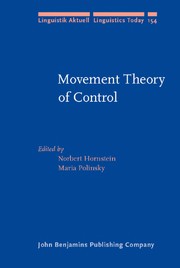
Movement theory of control
Norbert Hornstein · 2010
על הספר
Natural languages offer many examples of "displacement," i.e. constructions in which a non-local expression is critical for some grammatical end. Two central examples include phenomena such as raising and passive on the one hand, and control on the other. Though each phenomenon is an example of displacement, they have been theoretically distinguished. Movement rules have generated the former and formally very different construal rules, the latter. The Movement Theory of Control challenges this differentiation and argues that the operations that generate the two constructions are the same, the differences arising from the positions through which the displaced elements are moved. In the context of the Minimalist Program, reducing the class of basic operations is methodologically prized. This volume is a collection of original papers that argue for this approach to control on theoretical and empirical grounds as well. The papers also develop and constrain the movement theory to -- account for novel phenomena from a variety of languages. --Book Jacket.
פרטי הספר
- שנה
- 2010
- שפה
- English
- סדרה
- Linguistik aktuell/Linguistics today -- v. 154
- הוצאה
- John Benjamins Pub. Company
- מהדורות
- 1
- עמודים
- 330
- ISBN
- 9789027255372
מקור הנתונים: Wikidata
עוד של Norbert Hornstein