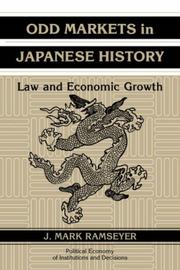
Odd Markets in Japanese History
J. Mark Ramseyer · 1996
על הספר
Using a straightforward rational-choice approach, Professor Ramseyer explores the impact that law had on various markets in Japanese history and the effect that those markets had on economic growth. In doing so, he applies an economic logic to markets in a different world in a different historical period with a different political regime and a different legal system. He looks hardest at those markets that have most often struck traditional observers as "exploitative" (e.g., the markets for indentured servants and for sexual services). Within those markets, he focuses on the way participants handled informational asymmetries in the contracting process. Ramseyer finds that Japanese courts generally defined important property rights clearly, and that Japanese markets generally protected an individual's control over his or her own labor. As a result, that the Japanese economy grew at relatively efficient levels follows directly from standard economic theory. He also concludes that the legal system usually promoted mutually advantageous deals, and that market participants (whether poor or rich, female or male) generally mitigated informational asymmetries shrewdly by contract. He finds no systematic evidence of either sex- or age-based exploitation.
המשפט הראשון: "I see the world in very fluid, contradictory, emerging, interconnected terms," Jerry Brown once observed, "and with that kind of circuitry I just don't feel the need to say what is going to happen or will not happen."
פרטי הספר
- שנה
- 1996
- שפה
- English
- הוצאה
- Cambridge University Press
- מהדורות
- 1
- עמודים
- 208
- ISBN
- 9780521048255
מקור הנתונים: Wikidata
עוד של J. Mark Ramseyer