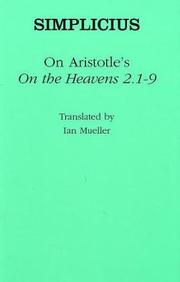
On Aristotle "On the Heavens 2.1-9" (Ancient Commentators on Aristotle Series)
Simplicius of Cilicia · 2004
על הספר
"Aristotle believed that the outermost stars are carried round us on a transparent sphere. There are directions in the universe and a preferred direction of rotation. The sun moon and planets are carried on different revolving spheres. The spheres and celestial bodies are composed of an everlasting fifth element, which has none of the ordinary contrary properties like heat and cold which could destroy it, but only the facility for uniform rotation. But this creates problems as to how the heavenly bodies create light, and, in the case of the sun, heat. The value of Simplicius' commentary on On the Heavens 2, 1-9 lies partly in its preserving the lost comments of Alexander and in Simplicius' controversy with him. The two of them discuss not only the problem mentioned, but also whether soul and nature move the spheres as two distinct forces or as one. Alexander appears to have simplified Aristotle's system of 55 spheres down to seven, and some hints may be gleaned as to whether, simplifying further, he thinks there are seven ultimate movers, or only one."--Bloomsbury Publishing Aristotle believed that the outermost stars are carried round us on a transparent sphere. There are directions in the universe and a preferred direction of rotation. The sun moon and planets are carried on different revolving spheres. The spheres and celestial bodies are composed of an everlasting fifth element, which has none of the ordinary contrary properties like heat and cold which could destroy it, but only the facility for uniform rotation. But this creates problems as to how the heavenly bodies create light, and, in the case of the sun, heat. The value of Simplicius' commentary on On the Heavens 2,1-9 lies both in its preservation of the lost comments of Alexander and in Simplicius' controversy with him. The two of them discuss not only the problem mentioned, but also whether soul and nature move the spheres as two distinct forces or as one. Alexander appears to have simplified Aristotle's system of 55 spheres down to seven, and some hints may be gleaned as to whether, simplifying further, he thinks there are seven ultimate movers, or only one.
פרטי הספר
- שנה
- 2004
- שפה
- English
- הוצאה
- Gerald Duckworth & Co Ltd
- מהדורות
- 1
- עמודים
- 256
- ISBN
- 9780715632000
מקור הנתונים: Wikidata
עוד של Simplicius of Cilicia