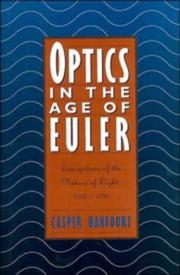
Optics in the age of Euler
Casper Hakfoort · 1995
על הספר
According to received historiography, the fundamental issue in eighteenth-century optics was whether light could be understood as the emission of particles or as the motion of waves in a subtle medium. Moreover, the emission theory of light was supposed to have been dominant in the eighteenth century, backed by Newton's physical arguments.This picture is enriched and qualified by focussing on the origins, contents, and reception of Leonhard Euler's wave theory of light published in 1746, here studied in depth for the first time. Contrary to what has been assumed, in an important sense, the particle-wave debate only starts with Euler. In addition, Euler's wave theory was the most popular theory in Germany for thirty-five years. Finally, when the emission view of light suddenly became dominant in Germany around 1795, new chemical experiments were crucial. Reflecting on the mathematical, experimental, and metaphysical aspects of physical optics, Casper Hakfoort provides as an epilogue a general picture of early modern science.
המשפט הראשון: The aim of this work is to make a two-fold contribution to the study of eighteenth-century science.
פרטי הספר
- שנה
- 1995
- שפה
- English
- הוצאה
- Cambridge University Press
- מהדורות
- 3
- עמודים
- 255
- ISBN
- 9780521035071
מקור הנתונים: Wikidata