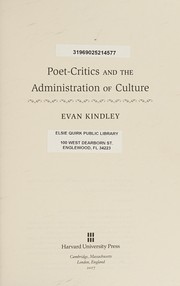
Poet-critics and the administration of culture
Evan Kindley · 2017
על הספר
The period between 1920 and 1950 saw an epochal shift in the American cultural economy, from a literary modernism largely sustained by elite patronage to one supported by bureaucratic institutions oriented (at least in theory) toward the public good. The economic and political shocks of the 1929 market crash and the Second World War decimated much of the support for high modernist literature, and those writers who had relied on the largesse of wealthy benefactors were forced to find new protectors from the depredations of the free market. In Poet-Critics and the Administration of Culture, Evan Kindley argues that modernist poet-critics played a unique role in the shift from aristocratic patronage to technocratic administration. The book takes up a series of exemplary Anglo-American poet-critics -- including T.S. Eliot, Marianne Moore, W.H. Auden, Ezra Pound, Archibald MacLeish, Sterling A. Brown, and R.P. Blackmur -- in order to trace the evolution of the relationship between modernist literature and institutions like universities, philanthropic foundations, and the federal government. Poet-critics were "village explainers" (as Gertrude Stein once described Ezra Pound), but the kinds of audiences and entities to which they offered their explanations changed radically during this period, and the shift has important consequences for how we understand poetry and its place in our culture today.--
פרטי הספר
- שנה
- 2017
- שפה
- English
- הוצאה
- Harvard University Press
- מהדורות
- 3
- עמודים
- 164
- ISBN
- 9780674980075
מקור הנתונים: Wikidata