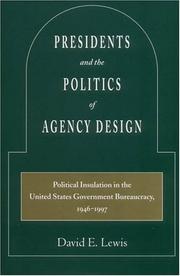
Presidents and the politics of agency design
David E. Lewis · 2003
על הספר
"The administrative state is the nexus of American policy making in the postwar period. The vague and sometimes conflicting policy mandates of Congress, the president, and courts get translated into real public policy in the bureaucracy. As the role of the national government has expanded, the national legislature and executive have increasingly delegated authority to administrative agencies to make fundamental policy decisions. How this administrative state is designed, its coherence, its responsiveness, and its efficacy determine, in Robert Dahl's phrase, "who gets what, when, and how." This study of agency design thus has implications for the study of politics in many areas." "The structure of bureaucracies can determine the degree to which political actors can change the direction of agency policy. Politicians frequently attempt to lock their policy preferences into place through insulating structures that are mandated by statute or executive decree. This insulation of public bureaucracies, such as the National Transportation Safety Board, the Federal Election Commission, and the National Nuclear Security Administration, is essential to understanding both administrative policy outputs and executive-legislative politics in the United States." "This book explains why, when, and how political actors create administrative agencies in such a way as to insulate them from political control, particularly presidential control."--Jacket.
פרטי הספר
- שנה
- 2003
- שפה
- English
- הוצאה
- Stanford Univ Press
- מהדורות
- 1
- עמודים
- 244
- ISBN
- 9780804745901
מקור הנתונים: Wikidata