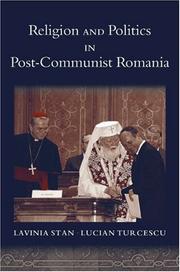
Religion and Politics in Post-Communist Romania (Religion and Global Politics)
Lavinia Stan · 2007
על הספר
Because these two authors have long given thought to the matter -- not least because they lived it, and at a price, when still in communist Romania -- they bring seasoned judgments and a rich analytic framework to the subject. --Richard Legvold, Foreign Affairs In this thoroughly researched and persuasively argued book, Lavinia Stan and Lucian Turcescu chart the complicated route that Romanian religious institutions have taken from Communism through European integration. The authors show the impact, as well as the limits, of the Romanian Orthodox Church's involvement in politics, and they are particularly insightful on the tortuous relationship between the church and state authority, both in the Communist period and after. Covering such diverse themes as religious education, the church and elections, and ecclesiastical views of sexuality, this important book will be of interest to scholars of Romania, post-communist politics, and church-state relations in general. Charles King, Georgetown University Lavinia Stan and Lucian Turcescu, in this path-breaking and incisive study, explain why the cultivation of ultranationalist sentiment and official support for the Orthodox Church went hand in hand under Communism, and why today democracy and pluralism are regarded by some leaders of the Orthodox Church as the principal enemy. They analyze the Orthodox Church's opposition to Romania's accession to the European Union and judiciously assess the challenges facing a church badly compromised by servility to the despot Ceausescu. Dennis Deletant, University College of London, author of Hitler's Forgotten Ally: Ion Antonescu and his Regime, Romania, 1940-1944 This is a masterful interpretation of the role of religion in influencing the development of modern Romania which is presented to the reader with clarity and analytical rigor. As well as sparkling comparative insights, the authors relate how religious claims and the reaction to them from the state and civil society are determining the extent to which Romania becomes a politically and socially free entity. The Orthodox Church is at the centre of the narrative and there are well-argued accounts of its relationship with nationalism, the communist past and the democratic present as Romania embraces capitalism and joins the European Union. Besides shedding light on a country whose direction is still shrouded in ambiguity, this is one of the most notable monographs to appear for quite a while on the role of religion in
פרטי הספר
- שנה
- 2007
- שפה
- English
- הוצאה
- Oxford University Press, USA
- מהדורות
- 1
- עמודים
- 288
- ISBN
- 9780195308532
מקור הנתונים: Wikidata
עוד של Lavinia Stan