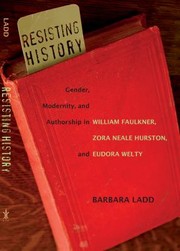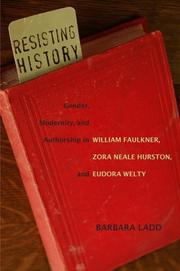
Resisting History
Barbara Ladd · 2007
איפה לקנות
בדקו את המחיר העדכני באמזון. אנחנו לא מציגים מחירים כי הם משתנים מדי יום.
לצפייה באמזוןקישור שותפים. בתור שותפים של Amazon אנחנו מרוויחים מרכישות מתאימות.
על הספר
"In a major reinterpretation, Resisting History reveals that women, as subjects of writing and as writing subjects themselves, played a far more important role in shaping the landscape of modernism than has been previously acknowledged. Here Barbara Ladd offers new readings of three southern writers who reimagined authorship between World War I and the mid-1950s." "Ladd argues that the idea of a "new woman" - released from some of the traditional constraints of family and community, more mobile, and participating in new contractual forms of relationality - precipitated a highly productive authorial crisis of gender in William Faulkner. As "new women" themselves, Zora Neale Hurston and Eudora Welty explored the territory of the authorial sublime and claimed, for themselves and other women, new forms of cultural agency. Together, these writers expose a territory of female suffering and aspiration that has been largely ignored in literary histories." "In opposition to the belief that women's lives, and dreams, are bound up in ideas of community and pre-contractual forms of relationality, Ladd demonstrates that all three writers - Faulkner in As I Lay Dying, Welty in selected short stories and in The Golden Apples, and Hurston in Tell My Horse - place women in territories where community is threatened or nonexistent and new opportunities for self-definition can be seized." "Resisting History challenges received ideas about history as a coherent narrative and about the development of U.S. modernism and points the way to new histories of literary and cultural modernisms in which the work of women shares center stage with the work of men."--BOOK JACKET.
פרטי הספר
- שנה
- 2007
- שפה
- English
- הוצאה
- Louisiana State University Press
- מהדורות
- 4
- עמודים
- 175
- ISBN
- 9780807132234
מקור הנתונים: Wikidata
עוד של Barbara Ladd