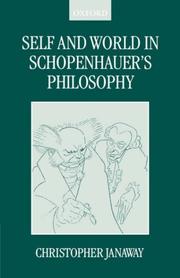
Self and world in Schopenhauer's philosophy
Christopher Janaway · 1989
על הספר
Centres on Schopenhauer's conception of the self and how it relates to the world, primarily dealing with his book The World as Will and Representation. It locates Schopenhauer in relation to Kant, of whom he was both a follower and a critic. While accepting Kant's transcendental idealism and the associated notion of the 'I' as a pure subject of knowledge distinct from the world of objects, Schopenhauer undercuts this notion with a conception of the self as will. The self as will is primarily active, embodied, organic, and manifests pre-rational ends and drives. The book shows how Schopenhauer arrives at a position in which idealism and materialism are correlative positions, but where a metaphysical account of the thing in itself as will takes primacy. It explores Schopenhauer's arguments that willing is identical with acting, and that at the level of individual willing there is no freedom. The book assesses the relevance of Schopenhauer's conception of the self to recent philosophical debates, and explores its influence on Wittgenstein and on Nietzsche.
המשפט הראשון: IN our study of Schopenhauer, the greatest single influence to consider is that of Kant.
פרטי הספר
- שנה
- 1989
- שפה
- English
- הוצאה
- Oxford University Press, USA
- מהדורות
- 1
- עמודים
- 390
- ISBN
- 9780198250036
מקור הנתונים: Wikidata
עוד של Christopher Janaway