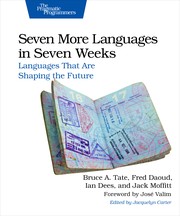
Seven More Languages in Seven Weeks
Bruce Tate · 2015
על הספר
Learn from the award-winning programming series that inspired the Elixir language. Hear how other programmers across broadly different communities solve problems important enough to compel language development. Expand your perspective, and learn to solve multicore and distribution problems. In each language, you'll solve a non-trivial problem, using the techniques that make that language special. Write a fully functional game in Elm, without a single callback, that compiles to JavaScript so you can deploy it in any browser. Write a logic program in Clojure using a programming model, MiniKanren, that is as powerful as Prolog but much better at interacting with the outside world. Build a distributed program in Elixir with Lisp-style macros, rich Ruby-like syntax, and the richness of the Erlang virtual machine. Build your own object layer in Lua, a statistical program in Julia, a proof in code with Idris, and a quiz game in Factor. When you're done, you'll have written programs in five different programming paradigms that were written on three different continents. You'll have explored four languages on the leading edge, invented in the past five years, and three more radically different languages, each with something significant to teach you. With each passing day, it is becoming more likely that new programmers will use functional programming, an entirely new programming paradigm. Each of the new languages has something unique to teach the next generation of programmers. 1. To learn functional programming, learn functional composition first. Programmers who want to improve themselves are learning functional programming in increasing numbers. Factor is a great language for learning about the composition of functions. The concatenative language forces new users to think through how functions will work together. 2. If you want to learn JavaScript, learn how prototypes work first in a simpler language. New JavaScript programmers are often better off learning a language like Lua first, which has the same overall model but fewer distracting concepts than JavaScript. 3. You don't need callbacks to build a beautiful user interface. Reactive programming is a new style of user interface development that helps build highly interactive and reliable applications. The Elm programming language is a language with reactive concepts baked in, from the inside out, and it compiles to JavaScript. 4. To build better cloud applications, your applications need to know how to fail.
פרטי הספר
- שנה
- 2015
- שפה
- English
- הוצאה
- Pragmatic Bookshelf
- מהדורות
- 1
- עמודים
- 320
- ISBN
- 9781941222157
מקור הנתונים: Wikidata
עוד של Bruce Tate