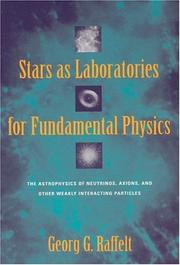
Stars as laboratories for fundamental physics
Georg G. Raffelt · 1996
על הספר
For centuries the heavens have been a natural laboratory to test the classical laws of motion, and more recently to test Einstein's theory of gravity. Today, astrophysics has become a vast playing ground for applications of the laws of microscopic physics, especially the properties of elementary particles and their interactions. Much of what we know about neutrinos is revealed by astronomical observations, and the same applies to the axion, a conjectured new particle that is a favored candidate for the main component of the dark matter of the universe. In this volume, Raffelt provides the first systematic review of what we know about these and other weakly interacting particles, and about the gravity, from the observed properties of stars, such as neutrino fluxes measured from the Sun and supernova 1987A, and from certain astronomical x- and gamma-ray observations. He discusses these results in the light of related information from both laboratory experiments and cosmological arguments. Much of this material has not been covered previously in the textbook literature on particle astrophysics, which focuses mainly on the early universe, neutrino physics, or cosmic rays. Therefore, this book should interest particle physicists, astrophysicists, and cosmologists both as an introduction to stars as sources for weakly interacting particles and as a reference text.
המשפט הראשון: Weakly interacting, low-mass particles such as neutrinos or axions contribute to the energy loss or energy transfer in stars.
פרטי הספר
- שנה
- 1996
- שפה
- English
- הוצאה
- University Of Chicago Press
- מהדורות
- 1
- עמודים
- 686
- ISBN
- 9780226702711
מקור הנתונים: Wikidata