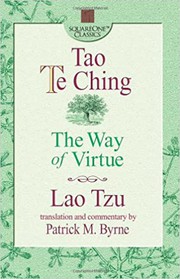
Tao Te Ching
Patrick Michael Byrne, PhD · 2001
איפה לקנות
בדקו את המחיר העדכני באמזון. אנחנו לא מציגים מחירים כי הם משתנים מדי יום.
לצפייה באמזוןקישור שותפים. בתור שותפים של Amazon אנחנו מרוויחים מרכישות מתאימות.
על הספר
A fundamental book of the Taoist, the Tao Te Ching is regarded as a revelation in its own right. It provides a wealth of wisdom and insights for those seeking a better understanding of themselves. Over time, many changes have been made to the original Chinese text. Researcher Patrick M. Byrne has produced a translation that is accurate and easy to understand, while capturing the pattern and harmony of the original. **Introduction** Legend has it that an elderly scholar in ancient China, a historian and philosopher perhaps twenty years senior to Confucius, journeyed to the western edge of the empire with the intent of wandering off into the wilderness. There at the frontier a gate-keeper, concerned that such a respected man of learning was soon to be lost to barbarian lands, asked the scholar to write a book to leave at the border. The old man distilled a lifetime of learning into about five thousand two hundred and fifty words, then left. There are over four hundred commentaries on those words, and fragments of several hundred more. It is the most dissected and analyzed book in Chinese literature; its effect on Chinese culture and thought rivals that of Confucius and Buddha. After the Bible, it is the most frequently translated piece of literature in the world; there are more than forty English versions. Yet the old man was laconic to the point of obscurity; rarely do any two commentaries agree on the exact meaning of his words, and agreement between translators has been rarer still. What is rendered by one, for example, as “The ruler in always carrying out the Tao / Does not abandon his tranquility and sedateness” is given by another as “Therefore the sage travels all day / Without leaving his baggage.” To complicate matters even further, it seems notes scribbled in the margins by some scholars were mistaken for lines of text by later readers, until literally dozens of versions of the book came into being. These in turn spawned more commentaries aimed at reconstructing the original text. At some point in the process, probably in the second century bc, the text was divided into eighty-one chapters. By the time of the great historian Si-ma Qian (Sze-ma Ch’ien, 185–136 bc?), the Herodotus of the Orient, the chapters had been arranged in two books: the first thirty-seven comprise the “higher” Book I, discussing Tao, while the latter forty-four make up the “lower” Book II, discussing Te. Tao and Te translate loosely as “way” and “virtue” (more on these conce
פרטי הספר
- שנה
- 2001
- שפה
- English
- הוצאה
- Square One
- מהדורות
- 1
- עמודים
- 128
- ISBN
- 9780757000294
מקור הנתונים: Wikidata