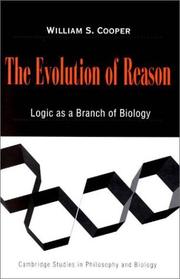
The Evolution of Reason
William S. Cooper · 2003
איפה לקנות
המחיר באמזון משתנה מדי יום, אז הכי נכון לראות אותו שם ברגע הקנייה.
לצפייה באמזוןזה קישור שותפים: כשקונים דרכו, האתר מקבל עמלה קטנה בלי תוספת במחיר עבורכם, וזה עוזר לנו להביא תוכן איכותי ולתחזק את האתר. בתור שותפים של Amazon אנחנו מרוויחים מרכישות מתאימות.
על הספר
Cooper defends a “reducibility thesis”: logic is reducible to evolutionary theory. That is, logical rules are directly derivable from evolutionary principles. As Cooper states, “according to the reductionist claim, logic is so biological that if the classical laws of logic had not already been worked out independently, an evolutionist innocent of any prior knowledge of formal logic could in principle have stumbled upon them simply by drawing out the consequences of standard evolutionary models and processes” (p. 12). Cooper supports the reducibility thesis by ascending a “ladder of reducibility”: he devotes a chapter each to showing how evolutionary theory implies life-history strategy theory; life-history strategy theory then implies decision theory; decision theory implies inductive logic; inductive logic implies deductive logic; and this in turn implies mathematics. Each of these things (descending the ladder now…) reduces back to the next (math to deductive logic a la the logicist paradigm, and so on) until you are back to life-history theory. This is a lot to do in 226 pages, so Cooper’s arguments and examples are sometimes impressionistic, as he freely admits. In order to accomplish the derivation of decision theory from life-history strategy theory, Cooper identifies subjective expected utility (SEU) with subjective fitness. This is problematic, he notes, as the founders of utility theory usually identify utility with pleasure (although contemporary decision theorists often proffer some version of desire satisfaction instead). Cooper argues that the structural fit between SEU and fitness is too good to pass up the identification of the two. Whether or not one finds Cooper’s argument persuasive will affect what one makes of the overall project…so it goes for basically every step up (or down) the ladder. The journey is an exhilarating one; Cooper’s book is filled with provocative suggestions, interesting asides, and creative identifications of functions and entities that are more familiar to logicians with purely biological processes and objects. A skeptic could put her foot on the brake at any of these junctures, but the ride is far too much fun to allow squeamishness to keep Cooper’s foot off the accelerator. [from review by William D. Casebeer, Human Nature Review 2003 Volume 3: 303-305, http://human-nature.com/nibbs/03/cooper.html]
פרטי הספר
- שנה
- 2003
- שפה
- English
- הוצאה
- Cambridge University Press
- מהדורות
- 3
- עמודים
- 236
- ISBN
- 9780521540254
מקור הנתונים: Wikidata
עוד של William S. Cooper