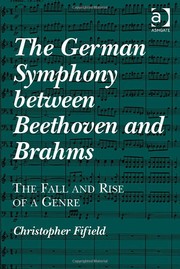
The German Symphony Between Beethoven and Brahms
Christopher Fifield · 2015
על הספר
It was Carl Dahlhaus who coined the phrase "dead time" to describe the state of the symphony between Schumann and Brahms. Christopher Fifield argues that many of the symphonies dismissed by Dahlhaus made worthy contributions to the genre. He traces the root of the problem further back to Beethoven's ninth symphony, a work which then proceeded to intimidate symphonists who followed in its composer's footsteps, including Schubert, Mendelssohn and Schumann. In 1824 Beethoven set a standard that then had to rise in response to more demanding expectations from both audiences and the musical press. Christopher Fifield, who has a conductor's intimacy with the repertory, looks in turn at the five decades between the mid-1820s and mid-1870s. He deals only with non-programmatic works, leaving the programme symphony to travel its own route to the symphonic poem. Composers who lead to Brahms (himself a reluctant symphonist until the age of 43 in 1876) are frequently dismissed as epigones of Beethoven, Mendelssohn and Schumann but by investigating their symphonies, Fifield reveals their respective brands of originality, even their own possible influence upon Brahms himself and in so doing, shines a light into a half-century of neglected nineteenth century German symphonic music. - Publisher.
פרטי הספר
- שנה
- 2015
- שפה
- English
- הוצאה
- Ashgate
- מהדורות
- 8
- ISBN
- 9781409452881
מקור הנתונים: Wikidata
עוד של Christopher Fifield